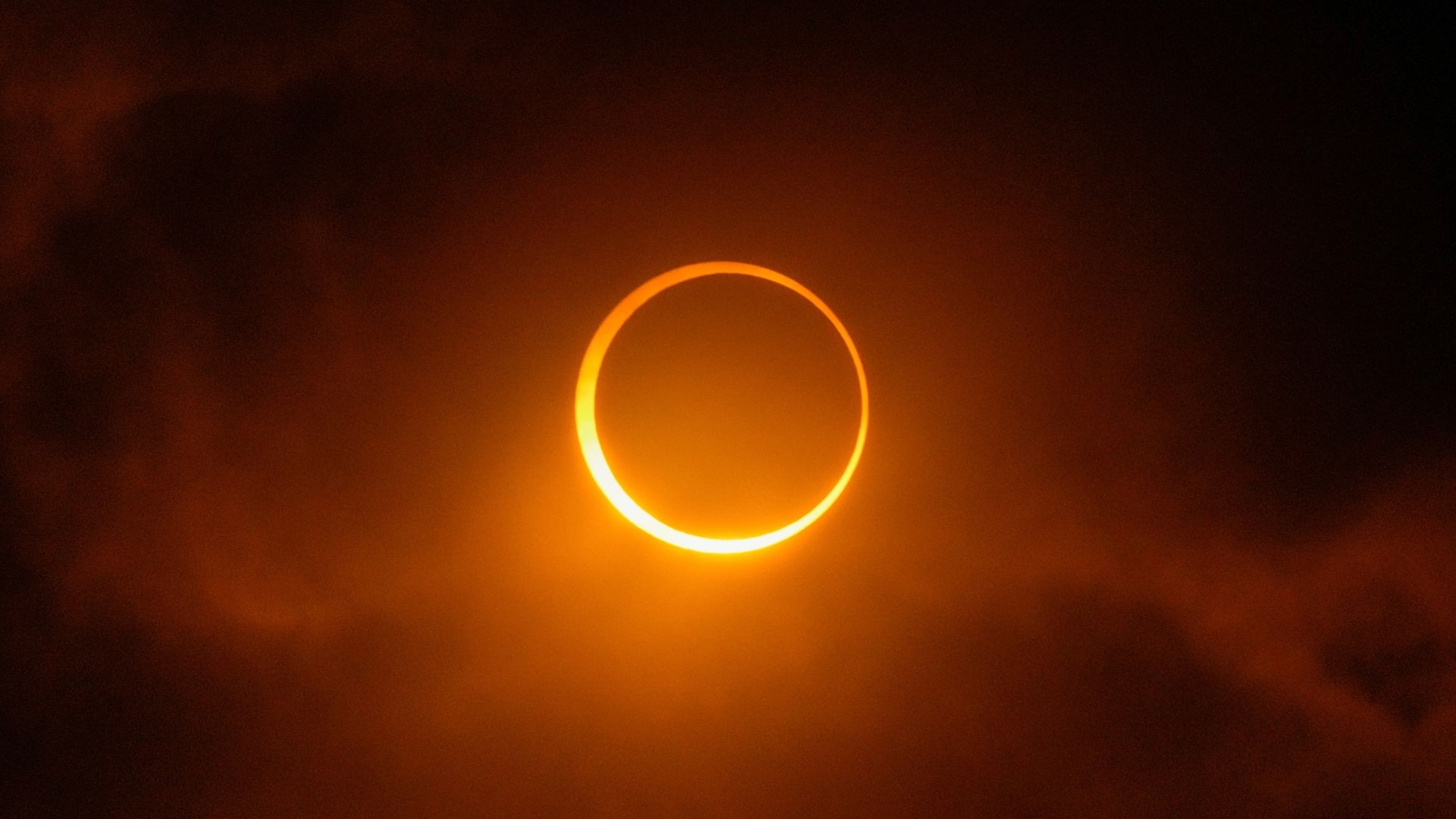
"The event, also called an annular solar eclipse, occurs "when the moon passes directly between the Earth and the sun, but the moon is too far away in its orbit to completely cover the sun's disk," Dr. C. Alex Young, associate director for science communication in the Heliophysics Science Division at NASA's Goddard Space Flight Center in Greenbelt, Maryland, said in an email."
"This results in a glowing ring of sunlight surrounding the moon's dark silhouette, he explained, giving it the name "ring of fire." If the moon completely covers the sun, it becomes a total eclipse. A partial solar eclipse happens when the moon passes between the sun and Earth, but the sun, moon, and Earth are not perfectly lined up, according to NASA."
An annular "ring of fire" solar eclipse occurs when the moon passes directly between Earth and the sun but remains too far away to fully cover the sun, producing a glowing ring. Only about 2% of the world's population will be able to view the eclipse; the best view will be from a sliver of Antarctica with partial visibility across the rest of Antarctica and parts of Africa and South America. Annular eclipses recur every one to two years but are often not widely visible. Another annular eclipse will occur on February 6, 2027, with broader visibility in South America and Africa. Eclipses occur in seasons, pairing a solar eclipse with a lunar eclipse roughly two weeks before or after; a total lunar eclipse will follow on March 3. The moon's shadow will carve a path 383 miles (616 kilometers) wide.
Read at ABC7 Los Angeles
Unable to calculate read time
Collection
[
|
...
]