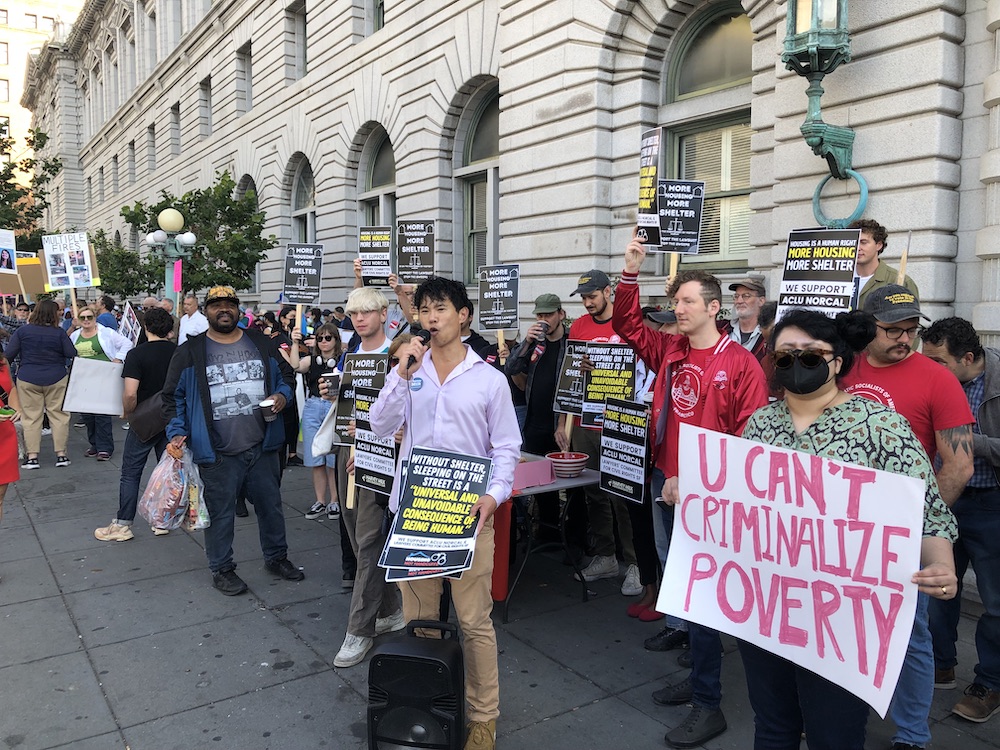
"No human should have to live on the streets. Yet, as low-income households in the United States face growing disparity between income and rents, homelessness is growing too. High rents are the greatest determiner of homeless rates. The antidote is not that complicated: Invest in housing that is affordable to the bottom third of the income ladder. Instead, the last half century trend has been for our leaders to vacillate between immoral inaction and blaming poor people for their poverty."
"Today we are on the political far right side of that pendulum, and about to fall off into a hellscape down below. From national decisions in Washington, to local decisions in San Francisco, the broad defunding of already inadequate homeless housing is underway. Despite this political landscape, we have made some progress. A focus on housing homeless vets led to reducing veteran homelessness by half nationally. While tens of thousands of extremely low-income San Franciscans are housed by public housing"
"In San Francisco, 14,000 unhoused households are waiting and registered under the Coordinated Entry System for housing, and many more lose their housing every day with rising rents. That's a bad situation with a whole lot of human suffering, compromised health and deteriorating mental health. It's about to get so much worse. Recently, the federal Department of Housing and Urban Development released the 2025 Continuum of Care Program Notice of Funding Opportunity"
Homelessness is increasing as low-income household incomes diverge from rising rents, with high rents the primary driver. Investing in housing affordable to the bottom third of the income ladder is presented as the solution. Political responses have alternated between inaction and blaming poor people, and current policy trends are shifting rightward with broad defunding of already inadequate homeless housing. Targeted efforts reduced veteran homelessness by half nationally. Tens of thousands of extremely low-income San Franciscans receive public housing, permanent supportive housing, and subsidies, but demand far outstrips supply. San Francisco has 14,000 households on the Coordinated Entry waiting list. A HUD 2025 Notice limits Continuum of Care allocations for supportive housing to 30 percent, risking an estimated $35 million loss in operating funds and worsening health and homelessness outcomes.
Read at 48 hills
Unable to calculate read time
Collection
[
|
...
]