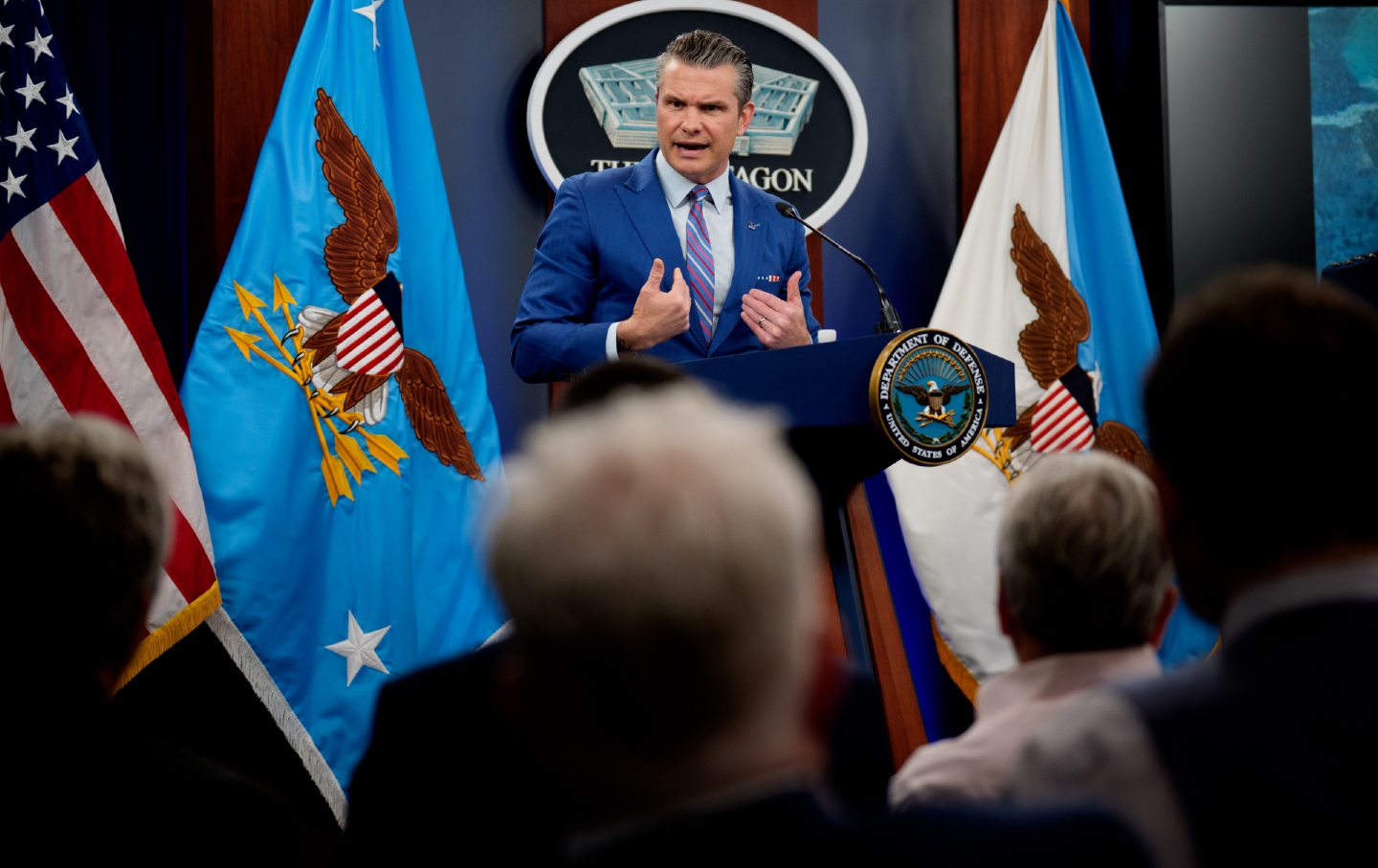
President Donald Trump asked top military leaders about making war in Iran. The Chairman of the Joint Chiefs of Staff urged caution, warning that intensified action could lead Iranian leaders to close the Strait of Hormuz. Trump recalled that Pete Hegseth supported striking Iran to prevent it from obtaining a nuclear weapon. Hegseth’s motivations are portrayed as seeking martial victory and a masculine transformation beyond other common reasons for joining the military. His Army career is described as involving deployments to Afghanistan and Iraq followed by public advocacy for the Pentagon’s occupation there. His public rhetoric is characterized as masking chaos and death while seeking personal validation from service.
"Earlier this year, President Donald Trump surveyed his top military brass on the prospect of making war in Iran. Chairman of the Joint Chiefs of Staff General Dan Caine urged caution, presciently predicting that a ramped-up campaign against Iran could lead its leaders to close the Strait of Hormuz. However, Pete Hegseth, Trump's self-styled “Secretary of War,” jumped at the prospect of such a conflict."
"“Pete, I think you were the first one to speak up,” Trump recently recalled at a press event. “And you said, 'Let's do it, because you can't let them have a nuclear weapon.'” Americans join the military for any number of reasons: to serve their country, gain economic stability, or simply join a community. For Hegseth, a thirst for martial victory and a desire for a masculine metamorphosis seemed to surpass all else."
"Much to Hegseth's chagrin, however, his career as an Army officer corresponded to a series of distinctly failed military campaigns. After graduating from Princeton in 2003, he deployed to two doomed military locales - Afghanistan and Iraq - and then relentlessly defended the Pentagon's occupation of parts of those places in essays, speeches, and, ultimately, as a weekend host on Fox News."
"While Hegseth's rhetoric on those wars long reflected mainstream Republican talking points - papering over chaos and death in the Middle East and beyond with pledges that stable democracies were close at hand - his zeal indicated something deeper: a desperation, it seemed, to wring some sort of personal validation from his time in uniform."
Read at The Nation
Unable to calculate read time
Collection
[
|
...
]