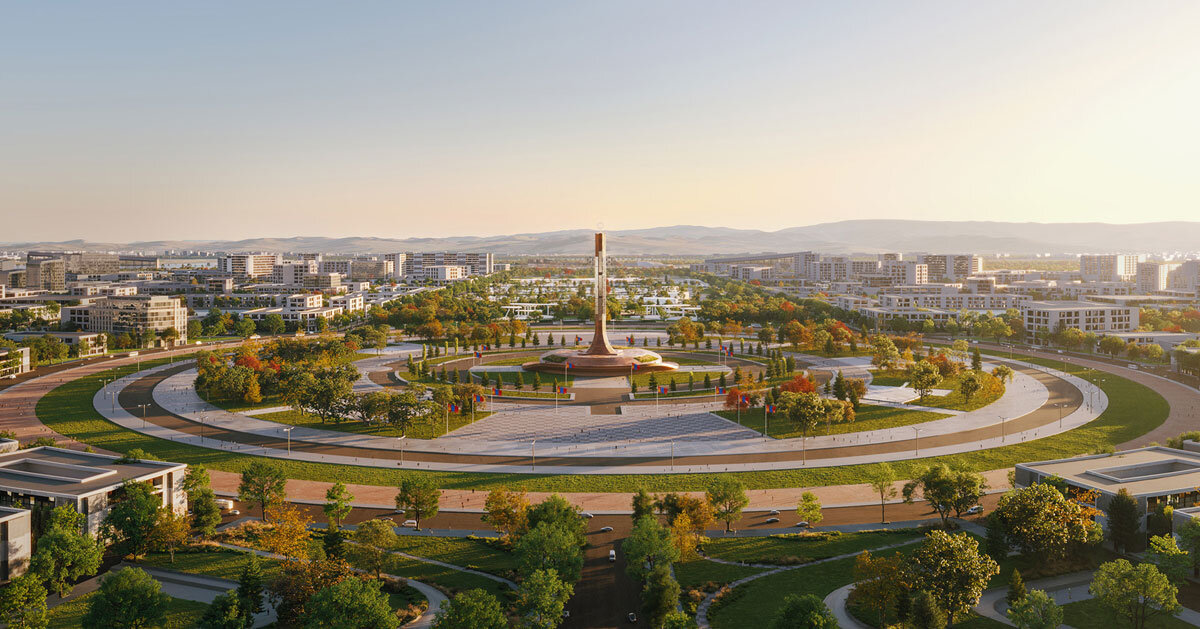
Tenger City proposes a satellite city approximately 52 kilometers south of Ulaanbaatar with phased development from 2025 to 2045. The plan aligns with national frameworks to promote decentralization, resilience, and long-term urban growth. The design embraces a 'City Without Walls' concept that maintains landscape continuity and visual connections to the horizon through a porous urban structure. The city is arranged as a network of specialized districts—University, Medical, Economic Free Zone, Administrative, and Cultural and Civic Core—anchored by recreational spaces such as Naadam Park. Peripheral markets, industry, and logistics support the economy while protecting residential and civic areas.
"Tenger City is an urban planning proposal by Sydney-based practice Squareone Atelier, awarded as a Top 3 Winner in the Hunnu City International Urban Planning Competition 2025. The project proposes a new satellite city located approximately 52 kilometers south of Ulaanbaatar, , with phased development planned between 2025 and 2045. The proposal forms part of Mongolia's broader Ulaanbaatar 2040 Masterplan and the national Vision 2050 framework, which aim to support decentralization, resilience, and long-term urban growth."
"The masterplan introduces a model for contemporary Mongolian urbanism informed by the spatial openness of the steppe and the country's nomadic traditions of movement and adaptability. Central to the proposal is the concept of a 'City Without Walls,' defined by a porous urban structure that prioritizes landscape continuity, ecological systems, and visual connections to the horizon. Rather than imposing rigid boundaries, the city is organized as an open framework that allows urban development to grow alongside natural systems."
"Tenger City is structured as a network of interconnected districts, each supporting specific civic and economic functions. These include a University Hub focused on education and research, a Medical Hub for healthcare and innovation, an Economic Free Zone supporting trade and enterprise, an Administrative District for governance, and a Cultural and Civic Core designed to host public events and performances."
Read at designboom | architecture & design magazine
Unable to calculate read time
Collection
[
|
...
]