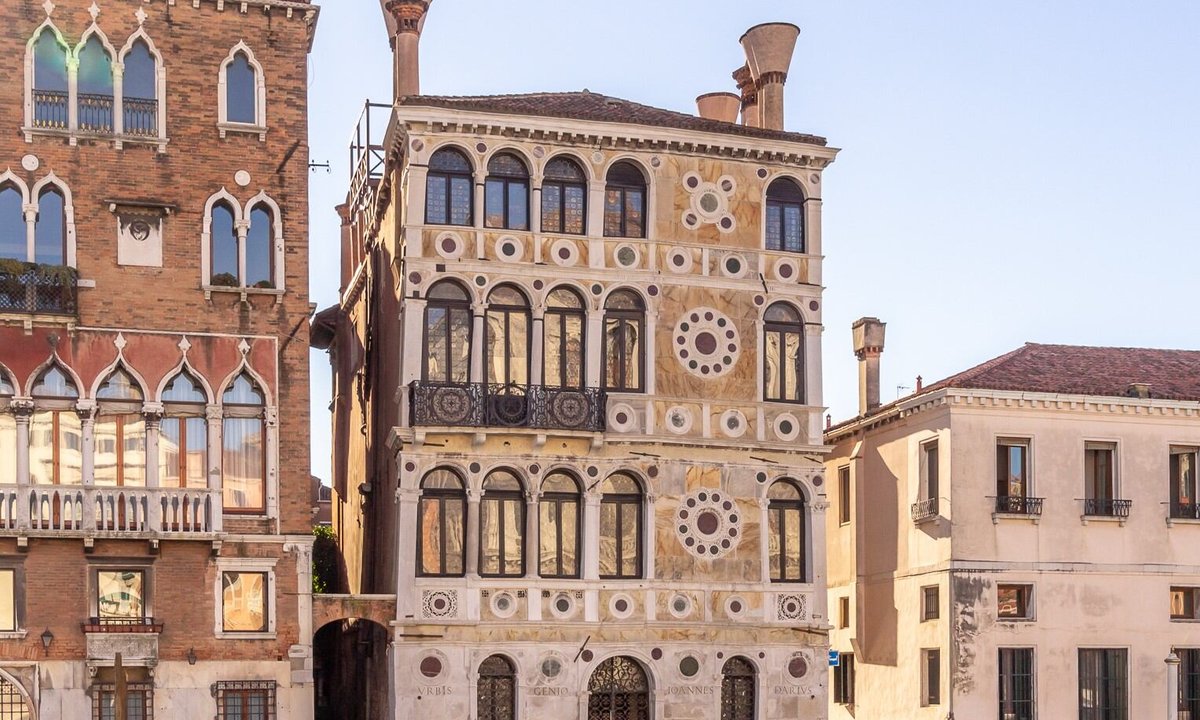
"Built in 1486 for Giovanni Dario, a patrician and former ambassador of the Venetian Republic, Ca' Dario spans five floors and boasts pillared marble bathrooms, an internal Moorish fountain, grand halls and internal decorations carved in Istrian limestone. Its most distinctive feature is its façade, patterned with circular designs in polychrome marble. The building, meanwhile, stands just metres from the Modern art-filled Peggy Guggenheim Collection, one of the city's most visited attractions."
"Monet painted the palazzo during his first trip to Venice in 1908, depicting it with the same hazy fluidity as the waters of the canal it overlooks. Ruskin sketched its façade in The Stones of Venice, his three-part study of Venetian architecture published between 1851 and 1853, praising the design as "Renaissance engrafted on Byzantine". The British-American writer Henry James described the building in his 1909 travelogue Italian Hours as resembling a house of cards that "would be fatal to touch"."
"The lavish residence has been spruced up before being put up for sale. Gardens have been tidied, trees and overgrown shrubs pruned, and the courtyard tidied up, Arnaldo Fusello of Christie's International Real Estate, which is overseeing the sale, told The Art Newspaper. The listing indicates that the price is available on request. Fusello declined to disclose a figure but said interest from potential buyers had been "very high"."
Ca' Dario is a five-floor palazzo on Venice's Grand Canal built in 1486 for Giovanni Dario, with ornate interiors and Istrian limestone decorations. The façade is patterned with circular polychrome marble designs and sits metres from the Peggy Guggenheim Collection. Claude Monet painted the palazzo in 1908; John Ruskin praised its design as "Renaissance engrafted on Byzantine" and Henry James likened it to a fragile house of cards. The residence has been cleaned and landscaped before a sale handled by Christie's International Real Estate, with price available on request and high buyer interest. The building retains an eerie reputation after Mario Del Monaco abandoned plans to buy following a serious car accident en route in 1964.
Read at The Art Newspaper - International art news and events
Unable to calculate read time
Collection
[
|
...
]