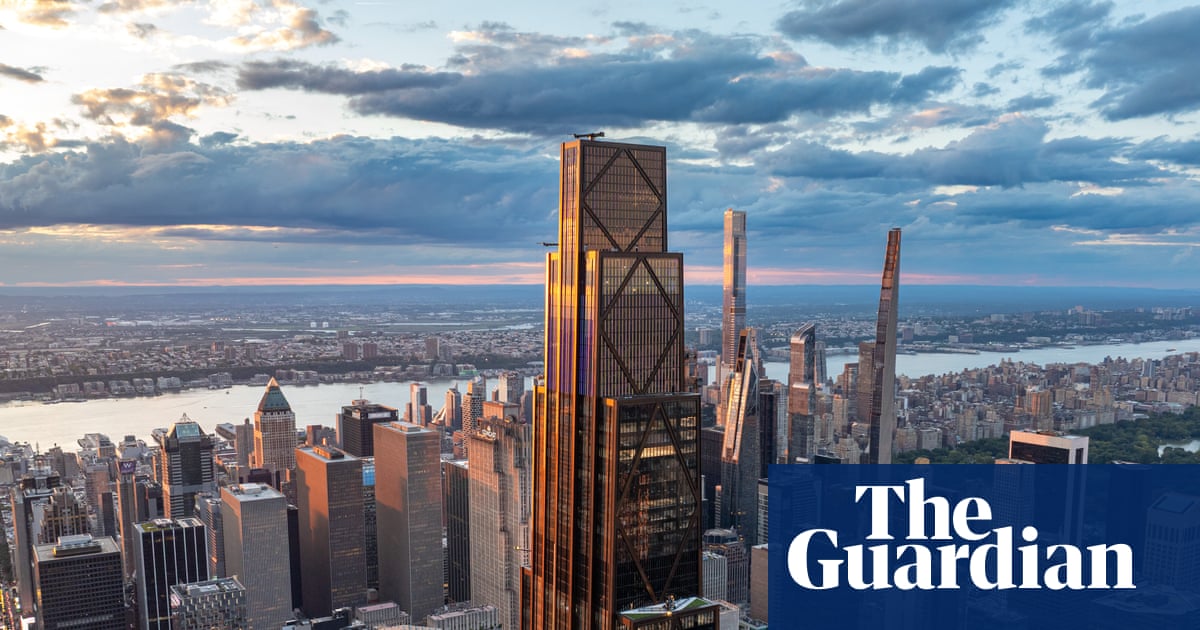
"Among the slender needles and elegant spires of the Manhattan skyline, a mountainous lump has reared into view. It galumphs its way up above the others, climbing in bulky steps with the look of several towers strapped together, forming a dark, looming mass. From some angles it forms the silhouette of a hulking bar chart. From others, it glowers like a coffin, ready to swallow the dainty Chrysler building that trembles in its shadow."
"Fittingly, this is the new global headquarters of JP Morgan, the world's biggest bank. The firm enjoys a market capitalisation of $855bn (645bn), more than Bank of America, Wells Fargo and Citigroup's combined, and it looks as if it might have swallowed all three inside its tinted glass envelope. Last year, for the first time, it made more than $1bn a week in profits."
"His HSBC tower in Hong Kong was the world's most expensive building when it opened in 1986, standing as a costly essay in structural redundancy, with a stack of steel suspension bridges bolted to its facade. It was described by one former partner as a sledgehammer to crack a nut. In comparison, the JP Morgan tower is like using a bronze-plated bulldozer to puree a pea."
An enormous, ominous tower now dominates Manhattan, rising in bulky stepped masses that resemble stacked towers, a bar chart or a coffin overshadowing the Chrysler Building. The building serves as JP Morgan's global headquarters and reportedly cost about $4bn. The bank enjoys a market capitalisation near $855bn and recorded more than $1bn a week in profits last year. Foster+Partners, led by Norman Foster, designed the structure, recalling earlier extravagant bank headquarters. The tower uses an extraordinary quantity of structural steel — 95,000 tonnes — creating a fortress-like presence that projects corporate strength and reinforces an in-office culture.
Read at www.theguardian.com
Unable to calculate read time
Collection
[
|
...
]