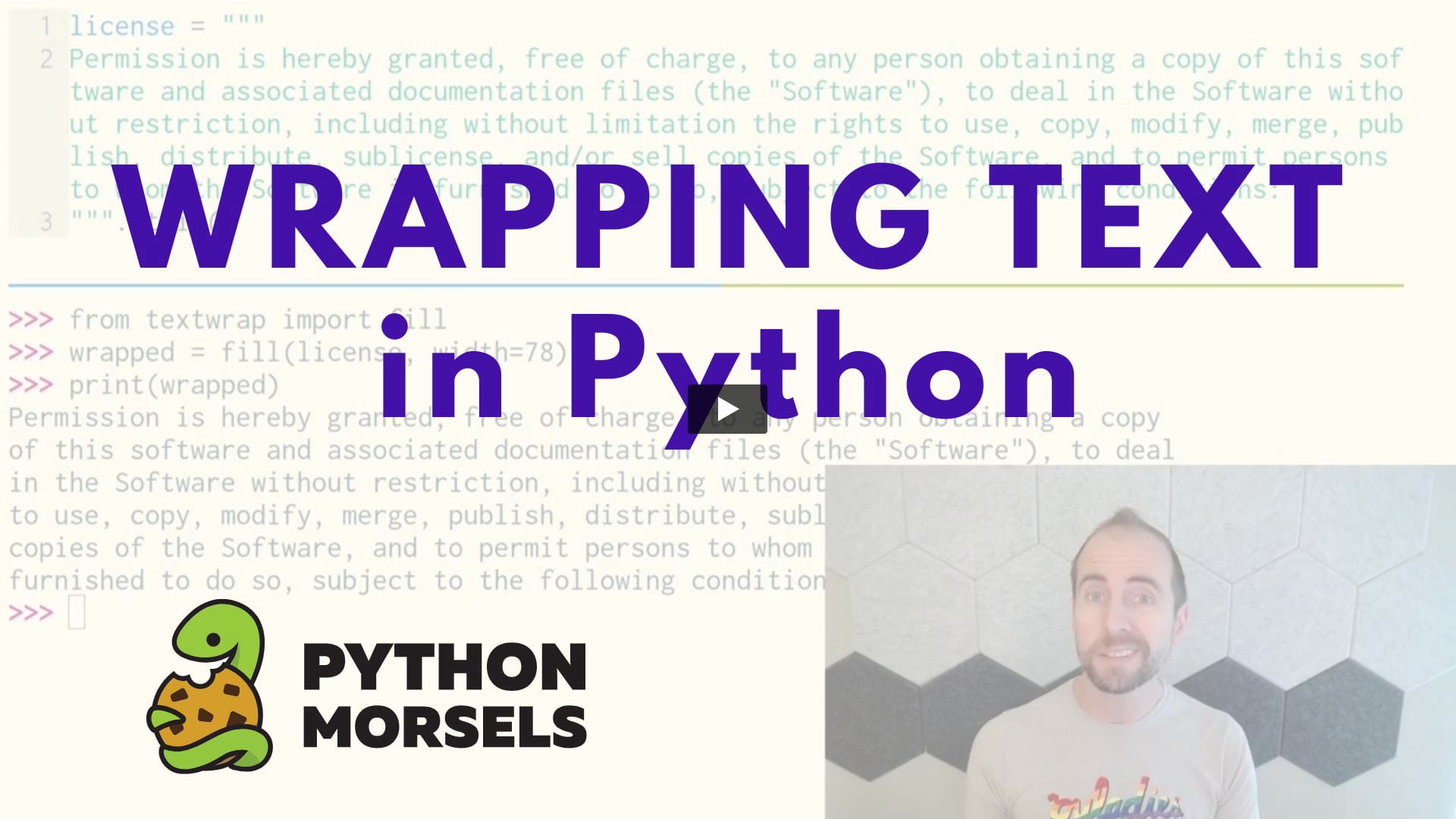
"How can we do this text wrapping automatically? Wrapping text to a fixed width with textwrap.wrap Python's textwrap module has a wrap function for wrapping text. If we pass our text to the wrap function, it will wrap our text to a maximum line length of 70 characters: To customize the length that we're wrapping to, we can pass the width keyword argument: Now we're wrapping to 78 characters."
"Permission is hereby granted, free of charge, to any person obtaining a copy of this software and associated documentation files (the "Software" ), to deal in the Software without restriction, including without limitation the rights to use, copy, modify, merge, publish, distribute, sublicense, and/or sell copies of the Software, and to permit persons to whom the Software is furnished to do so, subject to the following conditions:"
Python provides the textwrap module to enforce maximum line lengths and improve terminal readability. The wrap() function returns a list of wrapped lines and accepts a width keyword to customize the maximum line length, with a common default of 70 characters. The fill() function renders wrapped text as a single string with embedded newlines. Manually wrapping to a fixed width, such as 78 characters, makes license text and other long strings easier to read in terminals. The module simplifies programmatic control of line breaks for display and documentation.
Read at Pythonmorsels
Unable to calculate read time
Collection
[
|
...
]