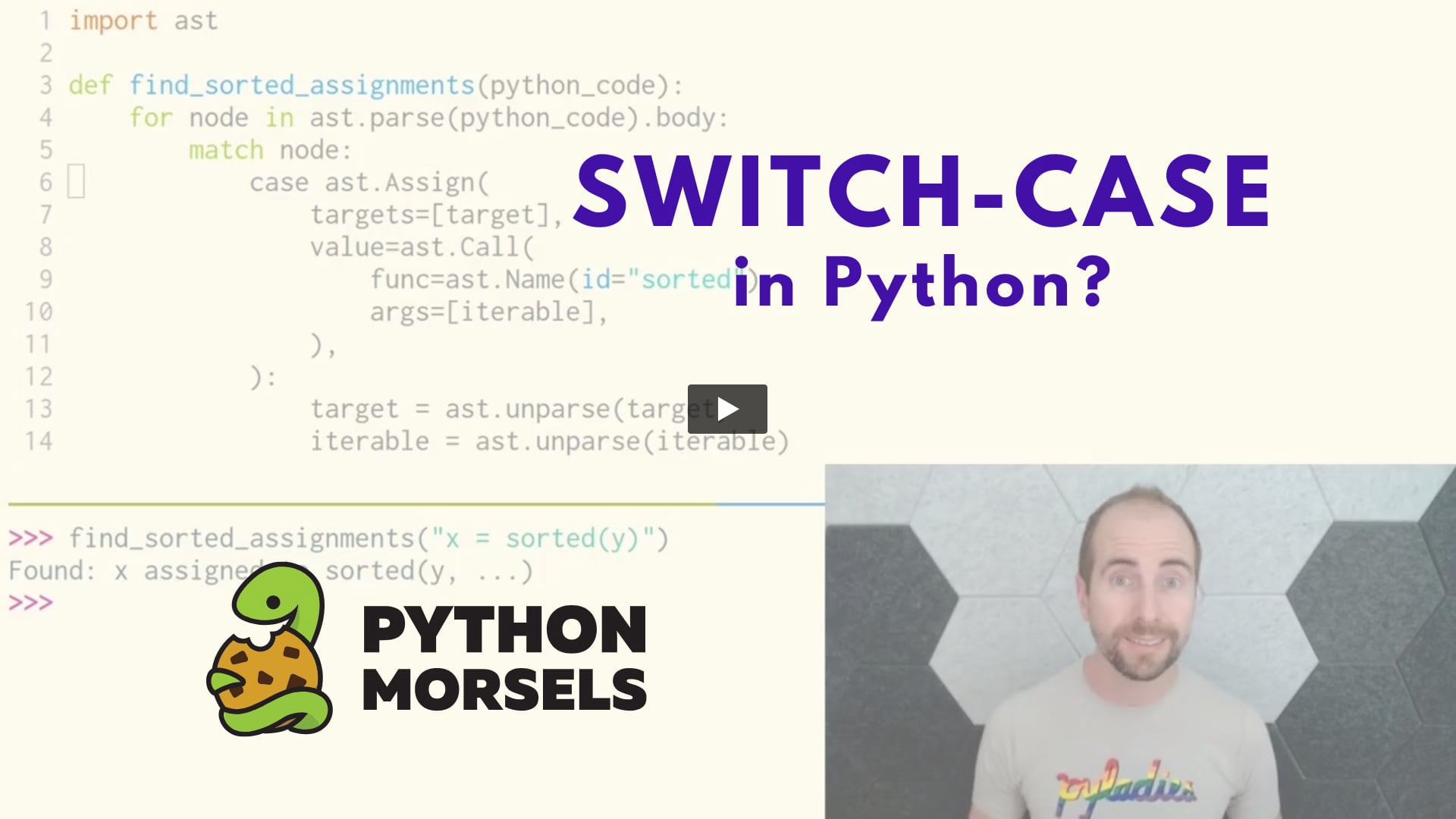
"Python does have a match- case statement, but it's not the same thing as switch- case. And usually, when you're looking for switch- case, I wouldn't recommend using match- case. Python's match statement is for structural pattern-matching, which sounds complicated because it is a bit complicated. The match statement has a different way of parsing expressions within its case statements that's kind of an extension of the way that Python parses code in general."
"Python's match statement can be used to match an iterable based on the number of items it contains (one, two, or three items, for example): The match statement can also match an iterable based on its actual values. Here, we're matching the first value as being move, and the second one as being either up, down, left, or right. Or we're matching the first value as being turn:"
"Matching objects by type and attributes The match statement can also match an object based on its type: It can also match objects based on the presence of certain attributes, or specific attributes having specific values: For example, this match- case statement will match the Point(0, 0) as at the origin, but Point(0, 1) as on the y-axis at position 1:"
Python's match statement implements structural pattern-matching that is different from a traditional switch-case. The match mechanism parses case expressions using an extended pattern syntax and supports matching based on iterable length and values. It can match dictionaries by the presence of keys and by specific key-value pairs. It can also match objects by their type and by attributes or specific attribute values. Nested patterns combine these forms for deep destructuring. Match-case is powerful for complex data shapes but is not always the recommended replacement when a simple switch-case behavior is desired.
Read at Pythonmorsels
Unable to calculate read time
Collection
[
|
...
]