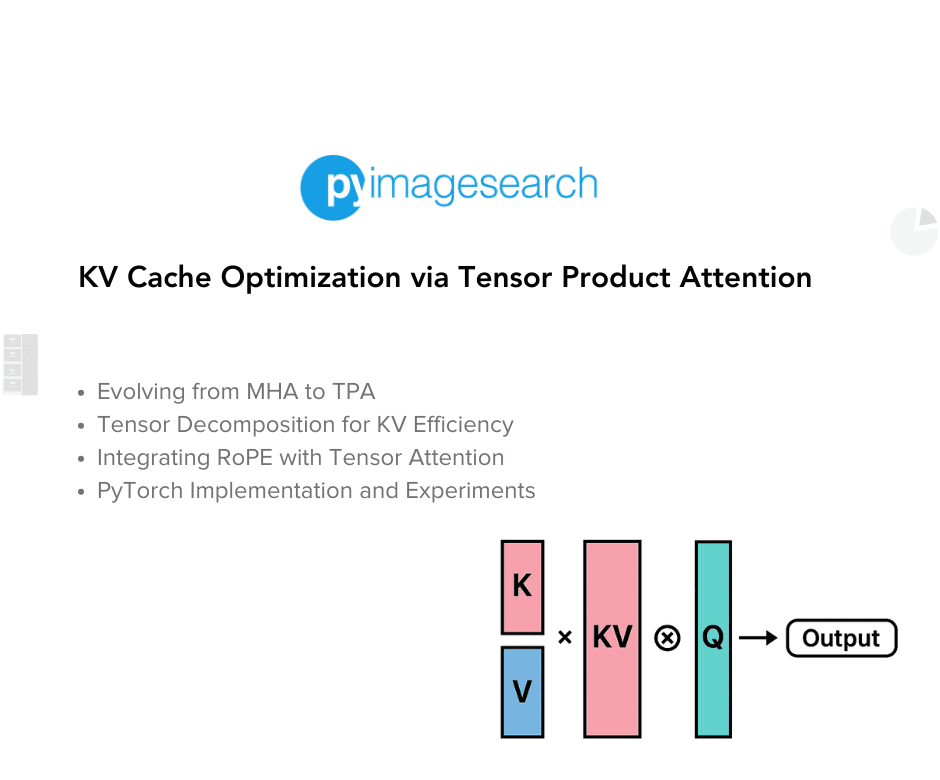
Grouped Query Attention (GQA) reduces KV cache by sharing keys and values across query groups, balancing expressiveness and efficiency. Multi-Head Latent Attention (MLA) reduces cache further by learning a compact latent space for attention heads, enabling scalable inference without quality loss. Tensor Product Attention (TPA) factorizes queries, keys, and values using tensor decompositions into low-rank contextual components, producing highly compact yet expressive representations. TPA markedly lowers KV cache size while preserving positional awareness through integration with Rotary Positional Embeddings (RoPE). TPA's low-rank factors enable scalable, high-performance LLM inference with reduced memory footprint.
"In the first two lessons of this series, we explored how modern attention mechanisms like Grouped Query Attention (GQA) and Multi-Head Latent Attention (MLA) can significantly reduce the memory footprint of key-value (KV) caches during inference. GQA introduced a clever way to share keys and values across query groups, striking a balance between expressiveness and efficiency. MLA took this further by learning a compact latent space for attention heads, enabling more scalable inference without sacrificing model quality."
"Now, in this third installment, we dive into Tensor Product Attention (TPA) - a novel approach that reimagines the very structure of attention representations. TPA leverages tensor decompositions to factorize queries, keys, and values into low-rank contextual components, enabling a highly compact and expressive representation. This not only slashes KV cache size but also integrates seamlessly with Rotary Positional Embeddings (RoPE), preserving positional awareness."
#tensor-product-attention #kv-cache-optimization #rotary-positional-embeddings-rope #tensor-decomposition
Read at PyImageSearch
Unable to calculate read time
Collection
[
|
...
]