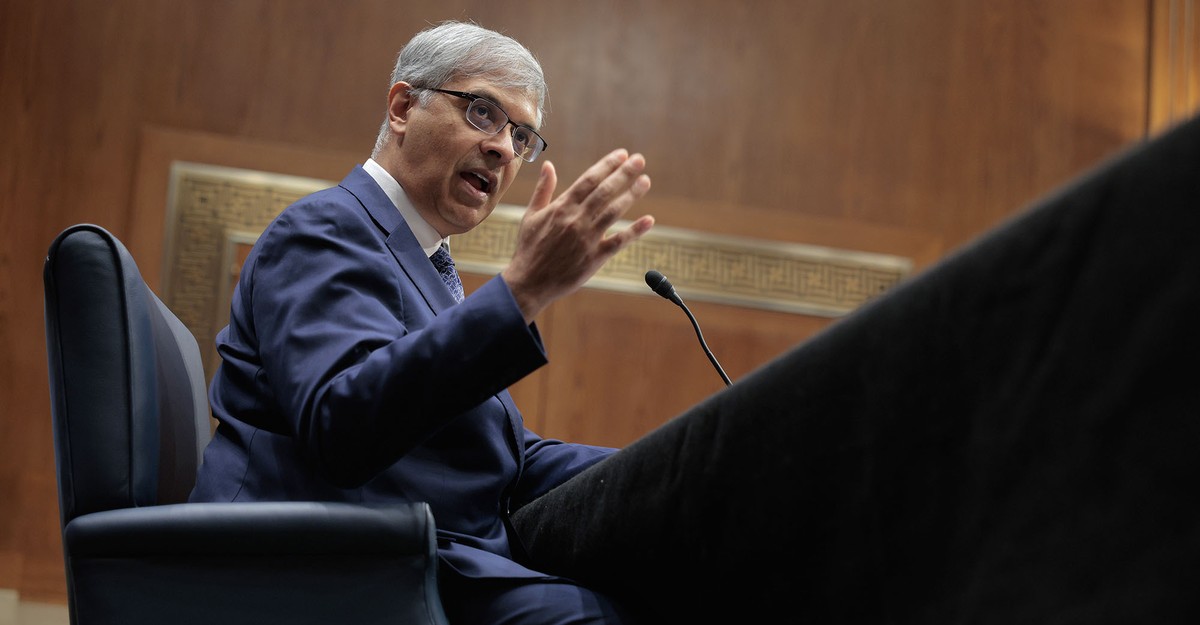
"In his first email to CDC staff, he wrote that the federal government's "decisions, communications, and processes" broke the public's trust during the pandemic, and that "acknowledging this reality is a necessary step toward renewal." In practice, the CDC has been undergoing a kind of forced renewal for months."
"Since Robert F. Kennedy Jr. took over as the secretary of the Department of Health and Human Services, thousands of people have been pushed out of the CDC, and several prominent agency leaders have resigned their post. Last year, Kennedy also dismissed the entirety of the agency's independent vaccine-advisory group, the Advisory Committee on Immunization Practices (ACIP), and replaced it with a more anti-vaccine cohort."
"When Donald Trump returned to office, he tapped Bhattacharya to lead the National Institutes of Health. And last month, Bhattacharya became the only person who has ever been tasked with directing the NIH and the Centers for Disease Control and Prevention at the same time."
Jay Bhattacharya, a Stanford health economist, gained prominence in 2020 by co-authoring the Great Barrington Declaration, which downplayed COVID-19 risks and advocated for early societal reopening. Health experts initially criticized this approach as dangerous. Under the Trump administration, Bhattacharya was appointed to lead the NIH and subsequently became acting CDC director, making him the first person to lead both agencies simultaneously. His tenure at the CDC appears temporary, with Trump planning to appoint a permanent director soon. Bhattacharya has signaled intentions to reform the CDC, citing broken public trust during the pandemic. Under Robert F. Kennedy Jr.'s leadership at the Department of Health and Human Services, the CDC has undergone substantial restructuring, including staff reductions, leadership resignations, and replacement of the vaccine advisory committee with members holding anti-vaccine positions.
#cdc-leadership #covid-19-policy #public-health-administration #vaccine-policy #trump-administration
Read at The Atlantic
Unable to calculate read time
Collection
[
|
...
]