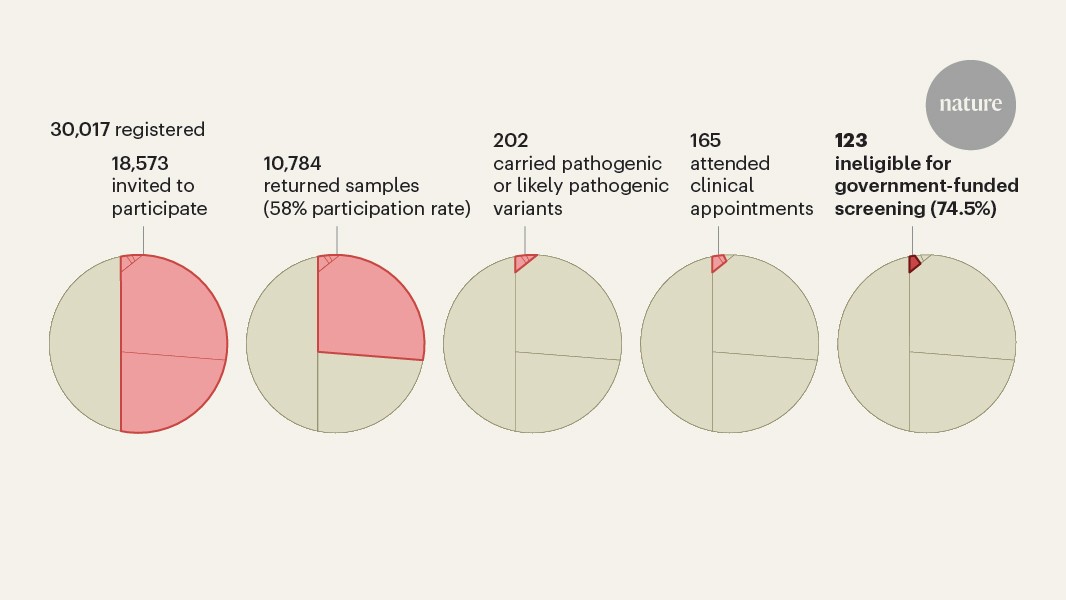
"Often, symptoms of these conditions become apparent only in late-middle or older ages, when they have progressed to advanced and potentially irreversible forms. Genetic screening for hereditary breast and ovarian cancer, colorectal cancer and familial hypercholesterolaemia (high cholesterol), as recommended by the US Centers for Disease Control and Prevention, can identify people who are at increased risk of these conditions long before they develop. This enables enhanced screening or treatment to prevent their often devastating consequences."
"Yet large-scale, population-wide genetic screening remains an unattained goal, with few studies having tested its feasibility and impact outside of selected private health systems. Writing in Nature Health, Lacaze et al. evaluated the uptake and yield (the number of at-risk individuals identified) of genetic screening among roughly 30,000 adults aged 18-40 years in a prospective nationwide pilot in Australia. The author declares no competing interests."
Cancer and cardiovascular disease are leading causes of death in high-income countries. Symptoms of these conditions frequently appear only in late-middle or older ages, by which time diseases may be advanced and potentially irreversible. Genetic screening for hereditary breast and ovarian cancer, colorectal cancer and familial hypercholesterolaemia can identify individuals at increased risk long before symptoms appear, enabling enhanced screening or treatment to prevent severe outcomes. Large-scale, population-wide genetic screening has not yet been achieved, and few studies have tested feasibility and impact outside selected private health systems. A prospective nationwide pilot in Australia assessed uptake and yield among roughly 30,000 adults aged 18–40 years. Generalizability and cost–benefit ratios need assessment in other settings.
Read at Nature
Unable to calculate read time
Collection
[
|
...
]