American children in the early 1960s commonly experienced unsupervised outdoor play, car travel without seat belts, and exposure to cigarette advertising on television. Measles, a highly contagious viral disease infecting roughly 90 percent of unimmunized contacts, infected nearly every child before middle school prior to the first vaccine's 1963 licensing. Vaccination dramatically reduced cases and led to measles elimination in the United States by 2000 after a full year without detected transmission. Recent declines in vaccination have produced outbreaks, including over 130 cases in South Carolina among mostly unvaccinated people, and nearly a year of continuous U.S. measles transmission, endangering elimination status.
"In the early 1960s, American childhood was not what it is today. Many children spent hours playing unsupervised in the streets; they rode around in cars without seat belts, then came home to frozen dinners, served in front of TVs blaring cigarette ads. And at some point, they'd almost certainly get measles. The illness-caused by a virus that is estimated to infect roughly 90 percent of the unimmunized people it comes into contact with-is widely considered one of the fastest-spreading diseases to ever plague humankind."
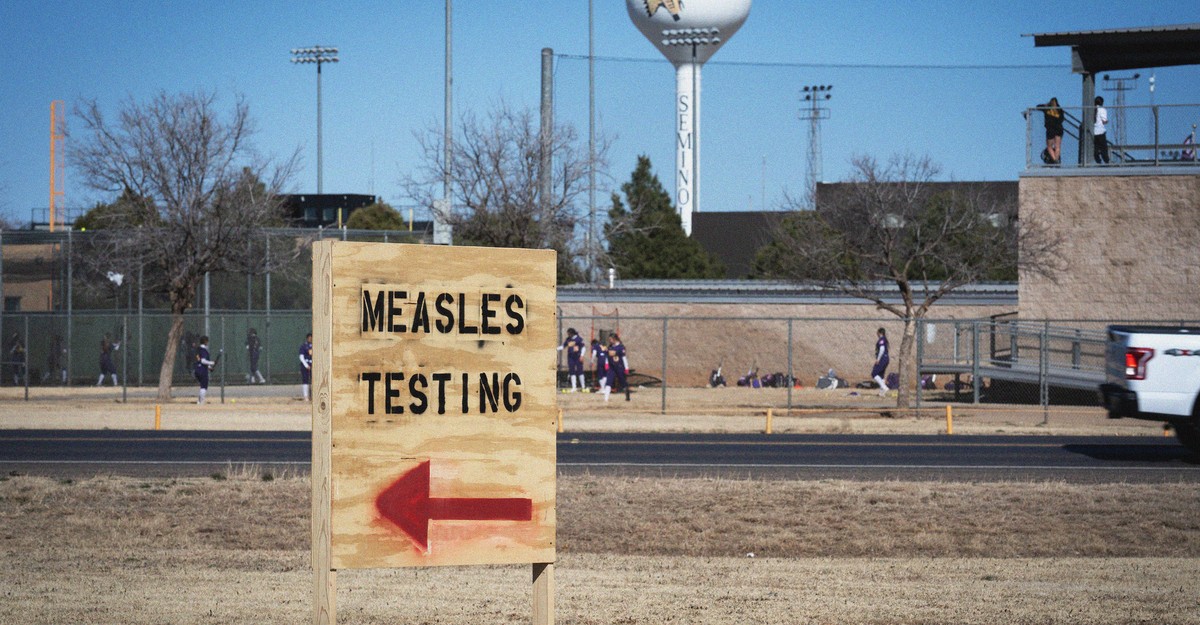
"But now measles outbreaks are igniting across the country in communities where vaccination rates have dropped-most recently in South Carolina, where officials have documented more than 130 infections, nearly all of them among unvaccinated people. The U.S. has now clocked nearly a year of continuous measles transmission; come January, the country will very likely lose the elimination status that took nearly four decades of vaccination to gain."
Read at The Atlantic
Unable to calculate read time
Collection
[
|
...
]