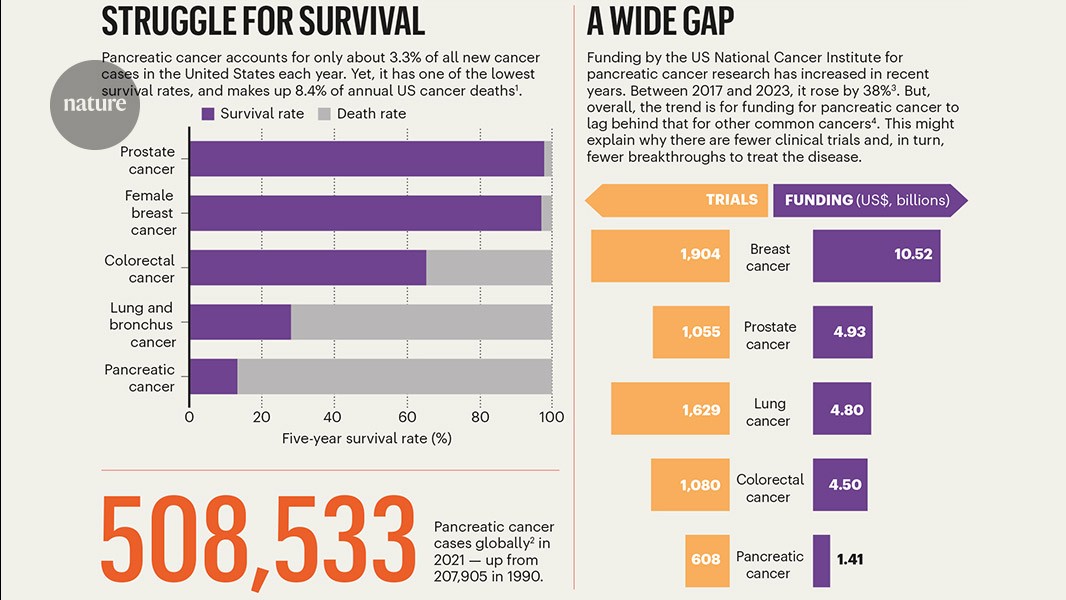
Pancreatic cancer causes a disproportionate share of cancer deaths despite representing a small percentage of new cases. Global incidence increased from about 207,905 cases in 1990 to 508,533 in 2021. US National Cancer Institute funding for pancreatic cancer research rose 38% between 2017 and 2023 but still lags behind funding for other common cancers, contributing to fewer clinical trials and treatment breakthroughs. Diagnoses have risen across age groups, with faster increases among people under 55 and especially US women aged 15–34. The disease is often asymptomatic and is frequently diagnosed after it has spread, driving low survival rates.
"Pancreatic cancer is one of the deadliest malignancies, and it is increasingly occurring in young people - especially women. An uptick in research funding is a welcome development in the push to transform treatment. You have full access to this article via your institution. Struggle for survival Pancreatic cancer accounts for only about 3.3% of all new cancer cases in the United States each year."
"A wide gap Funding by the US National Cancer Institute for pancreatic cancer research has increased in recent years. Between 2017 and 2023, it rose by 38%. But, overall, the trend is for funding for pancreatic cancer to lag behind that for other common cancers. This might explain why there are fewer clinical trials and, in turn, fewer breakthroughs to treat the disease."
"An alarming trend For unknown reasons, pancreatic cancer diagnoses have been rising for all age groups over the past few decades. For people under 55 years old, the incidence is increasing faster in women than it is in men. This is especially true for US women aged 15-34. In this group, the rate of increase in diagnoses between 2001 and 2018 was around three times that of young men."
Read at Nature
Unable to calculate read time
Collection
[
|
...
]