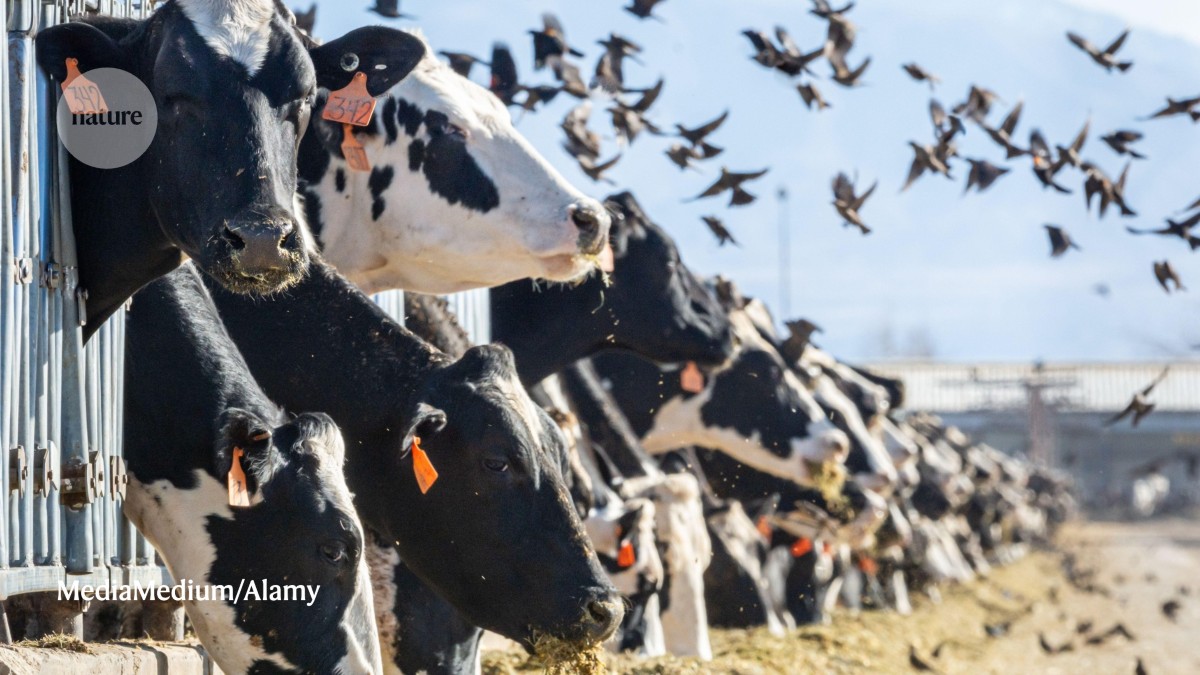
"Over the next few weeks, at dairies across Texas and New Mexico, cows started to get sick. They were losing their appetites and producing less milk than usual - and what little they did produce was thick and gluey. Deaths of birds such as crows and pigeons were also being reported. And then there were the barn cats. They were disappearing or dying suddenly, after becoming blind or unable to walk (see 'Is a lack of curiosity killing the cats?')."
"The bird and cat deaths were consistent with influenza - specifically, a type of highly pathogenic avian influenza (HPAI) known as H5N1 that had been circulating among wild birds and causing outbreaks on poultry farms across the country since early 2022. But H5N1 had never been known to infect cattle. As the weeks went on, dairy veterinarians across the region compared notes, messaging back and forth and organizing conference calls. Affected cows were tested for dozens of likely diseases, but to no avail."
"In late March 2024, milk samples from sick cows and tissue samples from barn cats that had died at a dairy in northern Texas were tested for avian influenza at the National Veterinary Diagnostic Laboratory in Ames, Iowa. The test was more to rule out the virus than anything else. "Nothing else was coming up positive," says Meghan Davis, a veterinary epidemiologist at the Johns Hopkins Bloomberg School of Public Health in Baltimore, Maryland. But both species were positive for H5N1."
In early 2024, barn cats disappeared from dairies in the southwestern United States, and cows across Texas and New Mexico developed loss of appetite, reduced milk production, and thick, gluey milk. Birds including crows and pigeons were dying, and barn cats were found blind, unable to walk, or dead. These deaths matched highly pathogenic avian influenza H5N1, a strain previously circulating in wild birds and poultry but not known to infect cattle. Dairy veterinarians compared notes and tested animals; late-March samples from a Texas dairy were confirmed H5N1, and by September 2025 more than 1,000 herds in 18 states were affected.
Read at Nature
Unable to calculate read time
Collection
[
|
...
]