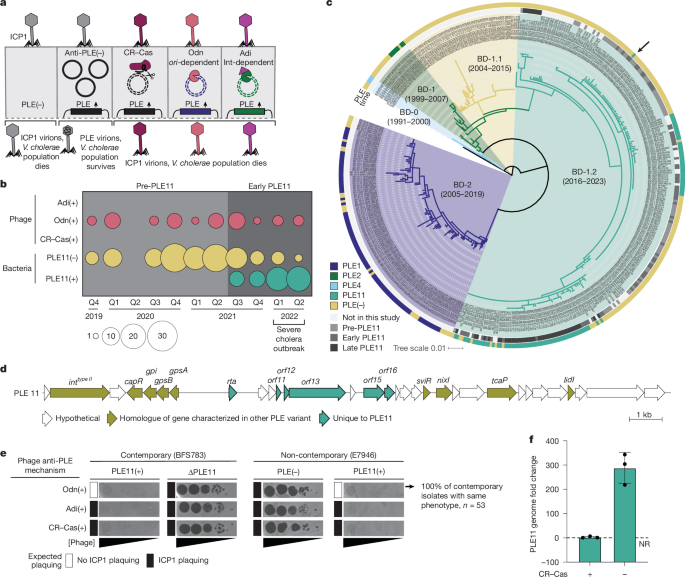
"Recent metagenomic analyses in cholera-endemic Bangladesh indicate that higher ratios of ICP1, the predominant lytic phage preying on V. cholerae in the context of disease, correlate with reduced risk of severe disease in patients. This suggests that the acquisition of phage resistance could contribute to outbreak severity and influence the evolution of pandemic lineages."
"PLEs have evolved intricate defence mechanisms that disrupt the phage life cycle while exploiting phage machinery and structural components to package themselves into modified viral particles, thereby blocking phage transmission. PLEs are highly specialized in safeguarding V. cholerae populations from predation by ICP1, but phage counteradaptations can neutralize their potent anti-phage activity."
"Analyses of sparsely collected ICP1 isolates have revealed three anti-PLE mechanisms the phage uses to overcome PLE-mediated hijacking and restore phage propagation. These mechanisms vary among phage isolates."
Cholera, caused by Vibrio cholerae, remains a significant global health threat, with seventh pandemic El Tor (7PET) strains originating from the Bay of Bengal. The evolution of these strains involves complex genetic changes and mobile genetic elements. Recent research shows that higher ratios of ICP1 phage correlate with reduced severe disease risk in cholera patients, suggesting phage resistance acquisition influences outbreak severity. Phage-inducible chromosomal island-like elements (PLEs) are mobile genetic elements that defend V. cholerae against ICP1 predation through specialized mechanisms that disrupt the phage life cycle. However, ICP1 phages have evolved counteradaptations with multiple anti-PLE mechanisms to overcome this defense and restore their propagation, creating dynamic oscillations in phage susceptibility and resistance.
#cholera-evolution #phage-bacteria-interactions #mobile-genetic-elements #pandemic-dynamics #antimicrobial-defense-mechanisms
Read at Nature
Unable to calculate read time
Collection
[
|
...
]