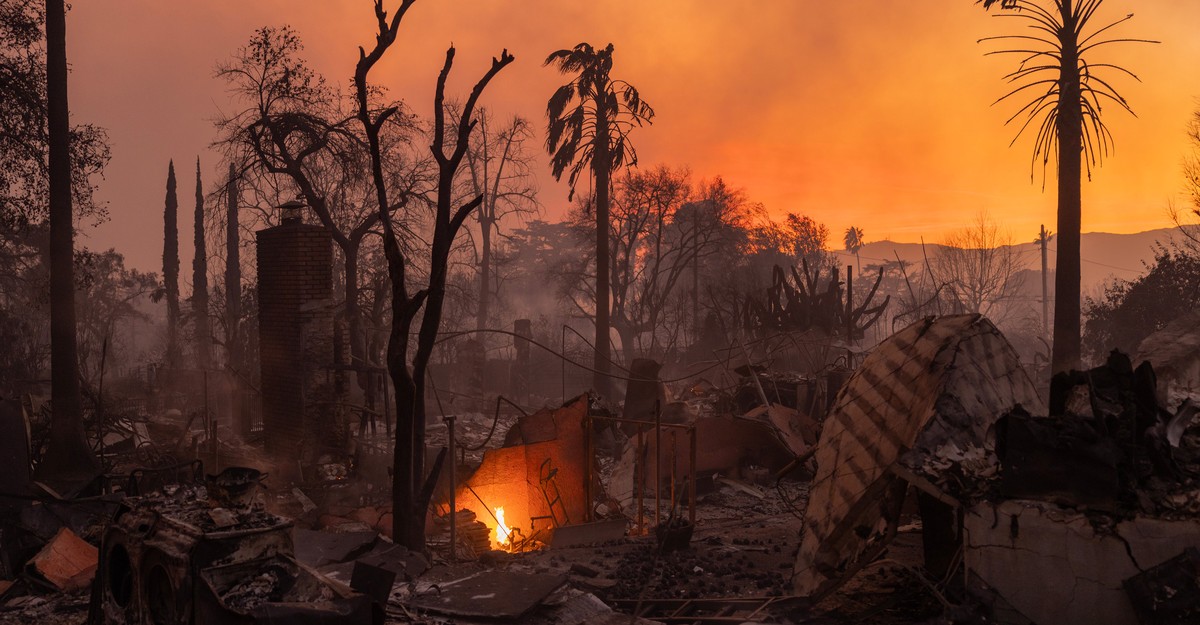
"Not all fires are the same, and although these fires started in the hills with scrub brush, they ended up in urban areas, flaming through more than 18,000 structures. "It's a new type of fire, because it's an urban conflagration," David Eisenman, a researcher at UCLA who has spent the past 25 years studying the impact of disasters on mental and physical health, told me."
"Some of these efforts will take years to become fully fleshed out. The Los Angeles Fire Human Exposure and Long-Term Health Study, for instance, is a multi-institution, 10-year effort to better understand the short- and long-term health impacts of the fires. A year after the fires, though, researchers have some early answers to what happens to mental and physical health after wildfires move from trees and shrubs to homes and buildings."
After one year, the Los Angeles fires are the most studied urban wildfires. The Palisades Fire reached UCLA's edge while the Eaton Fire approached Caltech, prompting local universities to deploy sensors and research teams. Scientists collected water, soil, and air samples and physicians began recruiting participants for long-term health research. The Los Angeles Fire Human Exposure and Long-Term Health Study is a multi-institution, ten-year effort to measure short- and long-term health impacts. Early findings address mental and physical health effects when wildfires transition from vegetation into homes and buildings. The fires consumed more than 18,000 structures, creating an urban conflagration.
Read at The Atlantic
Unable to calculate read time
Collection
[
|
...
]