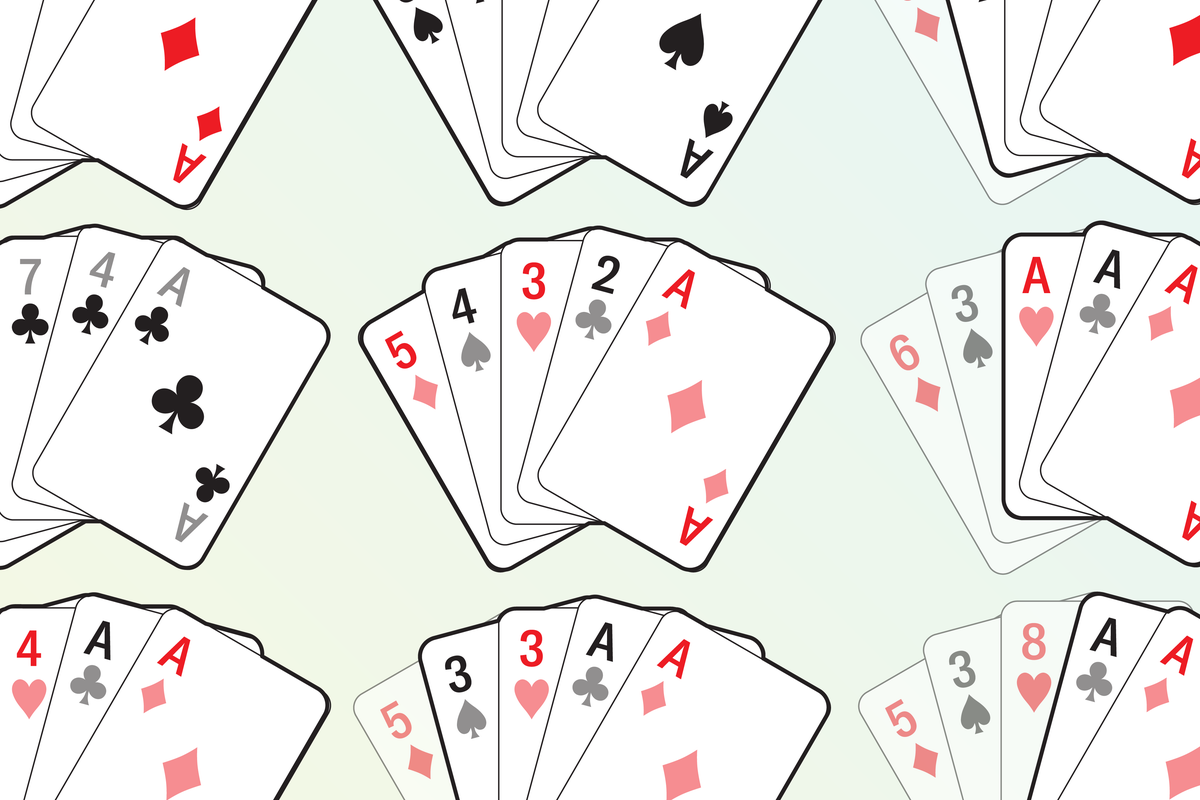
Texas Hold'em ranks five-card hands by their combinatorial probabilities, with rarer hands beating more common ones. Removing ranks 2 through 5 (short-deck) reduces suit counts and shifts relative rarities so that flushes can become less likely than full houses. Varying the number of cards per suit can produce paradoxical mismatches between formation probability and showdown probability. For example, a two pair can be less likely to form than a one pair yet have a higher chance of being the best hand at showdown. Changing hand rankings to fix such mismatches would alter strategic choices and thus the underlying probabilities again.
"In Texas Hold'em poker, players wager on the best five-card hand they can make among the two cards in their hand and the communal ones on the table. Hands are ranked based on their probability of occurring. A full house, for example, with three cards of the same value (fives or kings, for instance) and two cards of another, is less likely than a flush with any five cards of the same suit. A full house therefore beats a flush."
"In short-deck poker, a variant that removes cards numbered 2 through 5 (called ranks 25), there are fewer cards of each suit and a flush becomes less likely than a full house. In a recent paper posted to the preprint server arXiv.org, computer scientist Christopher Williamson examines how the game of poker changes as the number of cards per suit increases or decreases."
"After a bidding process, poker players will declare their best hands in what's called the showdown. Consider two hands: a one pair, which has one pair of cards with the same value, and a two pair, with two pairs of such cards. In short-deck poker, although a two pair is less likely to appear than a one pair, its showdown probabilitythe likelihood that it will be the best hand someone hasis actually higher than that of a one pair."
Read at www.scientificamerican.com
Unable to calculate read time
Collection
[
|
...
]