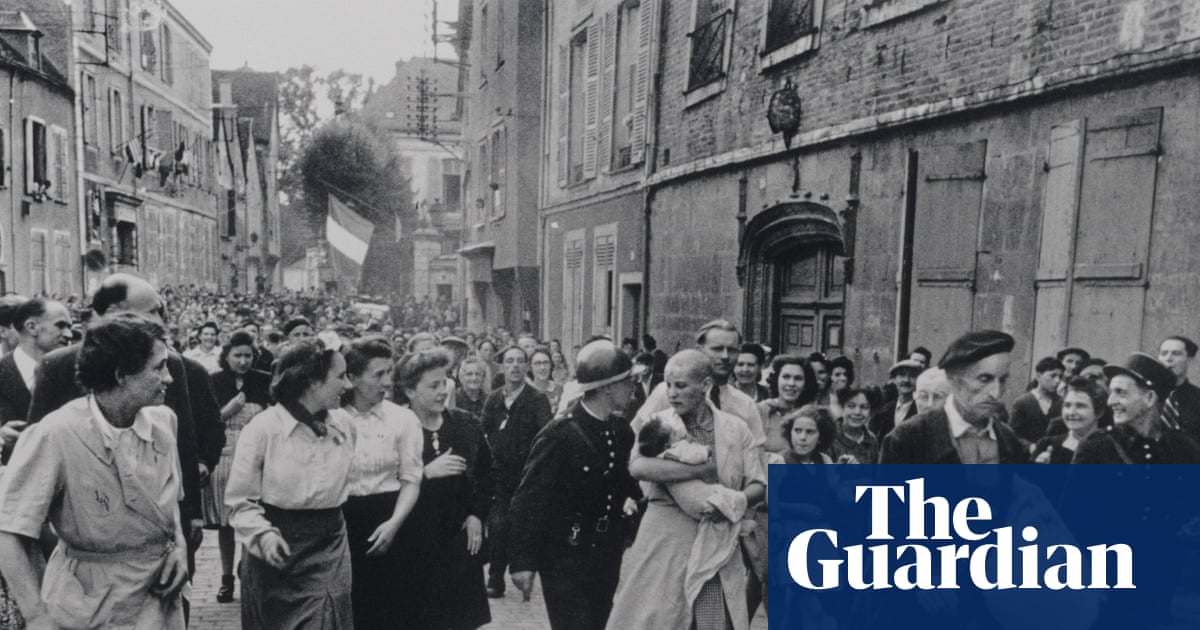
"It is not often that you get to see a war photographer at work. Certainly not one who more or less defines our idea of the profession as it exists today, is widely considered to be its greatest practitioner and has been dead for more than 70 years. But as part of its new retrospective, the Museum of the Liberation of Paris has produced a remarkable candid film of Robert Capa on the job."
"The researchers started with the 30 contact sheets 24 rolls of film, about 500 photographs the Hungarian-born photographer took on 25 and 26 August 1944, when the French capital was freed from four gruelling years of German occupation. Life, the multimillion-selling US magazine, published six of them in a 15-page spread entitled Paris Is Free Again that would further cement the fame of the man Britain's Picture Post had already dubbed the greatest war photographer in the world."
"The result, said Sylvie Zaidman, the museum director, was startling. He's there, she said. We found him. We can see him, with the Free French in the suburbs and De Gaulle on the Champs-Elysees. Dodging bullets on the rue Saint-Dominique. Above all, Zaidman said, the footage shows Capa working, his three cameras two Contaxes, a larger-format Rolleiflex around his neck, over two chaotic days in which up to 1,000 French resistants died: sprinting, crouching, mingling, spinning to"
Museum researchers matched 30 contact sheets and 24 rolls (about 500 photographs) taken by Robert Capa on 25–26 August 1944 to frames of US army film. They identified the precise locations where Capa worked and located him in archival footage across Paris during liberation. The footage shows Capa moving with Free French forces, photographing De Gaulle on the Champs-Élysées, and dodging bullets on rue Saint-Dominique. Capa is seen working with three cameras—two Contaxes and a larger-format Rolleiflex—over two chaotic days when up to 1,000 French resistants died.
Read at www.theguardian.com
Unable to calculate read time
Collection
[
|
...
]