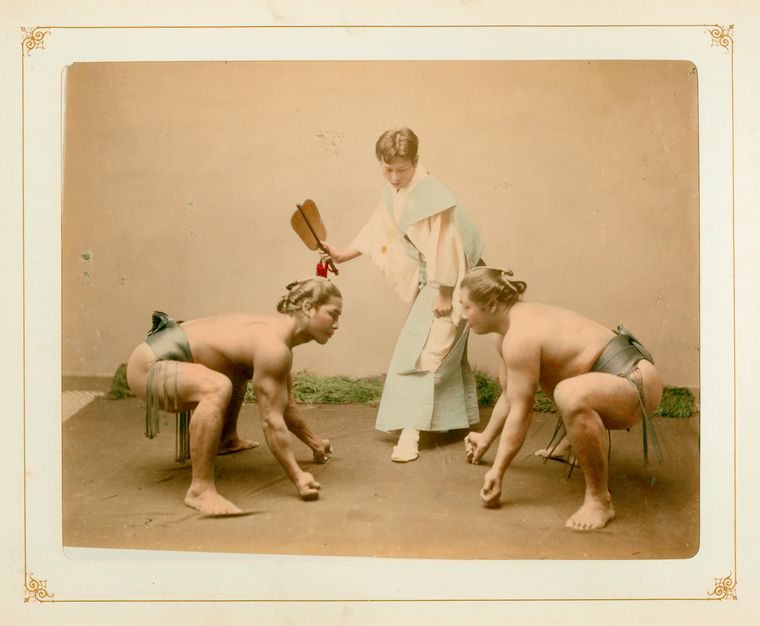
Between the fall of the Tokugawa shogunate in 1853 and the Meiji restoration in 1868, Japan experienced rapid social change driven by a forced influx of foreign capital and influence. Unemployment increased, domestic prices rose sharply, and famine spread in the mid-1860s. Foreigners also brought cholera. Alongside these impacts, photography arrived and was used by both Western and Japanese photographers to document Japan’s profound transformation and traditional dress and culture. After 200 years of closure, Japan became a major fascination for Western collectors and institutions, with photographic documentation and artifacts traveling across the sea. Photography spread through colonial processes and then took root with local photographers.
"Between the fall of the Tokugawa shogunate in 1853 and the Meiji restoration in 1868, Japanese society changed rapidly due to the sudden forced influx of foreign capital and influence, much of it destructive. "Unemployment rose," writes historian John W. Dower, "Domestic prices soared sky high.... Much of Japan was wracked by famine in the mid 1860s.... As if all this were not curse enough, the foreigners also brought cholera with them.""
"They also brought photography, and both Western and Japanese photographers documented not only the country's profound transformation, but also its traditional dress and culture. Closed for 200 years, Japan became a source of endless fascination for Westerners as artifacts made their way across the sea. Among them was "an extensive photographic documentation of Japan," notes the New York Public Library."
""In the broadest sense, photography entered Asia from Europe and America as part of the process of colonialism, but soon took root in those regions with local photographers." The colorized images you see here come from the NYPL's large collection of late 19th century Japanese photography, taken by photog"
Read at Open Culture
Unable to calculate read time
Collection
[
|
...
]