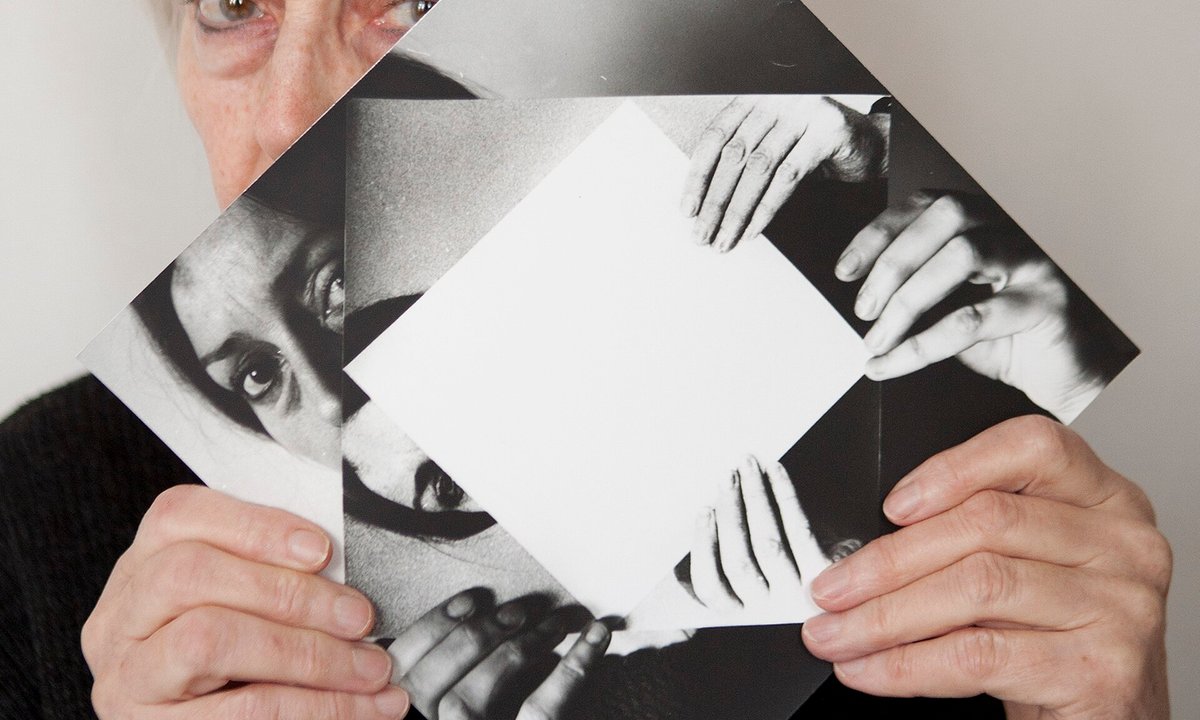
Dóra Maurer was born in Budapest on 11 June 1937 and died aged 88. The Széchenyi Academy of Literature and Arts confirmed her death; she had been its president since 2017. She graduated from the Hungarian Academy of Fine Arts in 1961, studying under Gyula Hincz and Sándor Ék. Maurer began as a printmaker and expanded into photography, film, performance and painting. From the late 1960s she produced conceptual photographic works and from the mid-1970s turned toward systematic painting and teaching. Her practice examined form, time and movement using mathematical processes to produce optical movement and chromatic tension. Key works include Quasi-images, Reversible and Changeable Phases of Movement, Seven Twists and Overlappings. She collaborated with Miklós Erdély, worked with InDiGó, taught from 1990 and became a full professor, influencing Hungarian artists and raising international recognition for Central European conceptual art.
"She began her career as a printmaker before expanding into photography, film, performance and painting. In the late 1960s and early 1970s she produced conceptual photographic works before turning increasingly towards painting and teaching from the mid-1970s onward. Her practice was marked by an intense exploration of form, time, and movement, often employing systematic or mathematical processes to generate visual effects."
"Among her best-known works are Quasi-images (1970-73), the series Reversible and Changeable Phases of Movement (1970s), Seven Twists (1979) and the Overlappings series (1970s-80s), in which layered geometric structures generate optical movement and chromatic tension. Although critics have at times read her work through a political lens, Maurer maintained that her practice was not conceived as political, suggesting such interpretations reflected the historical conditions in which it was produced."
Read at The Art Newspaper - International art news and events
Unable to calculate read time
Collection
[
|
...
]