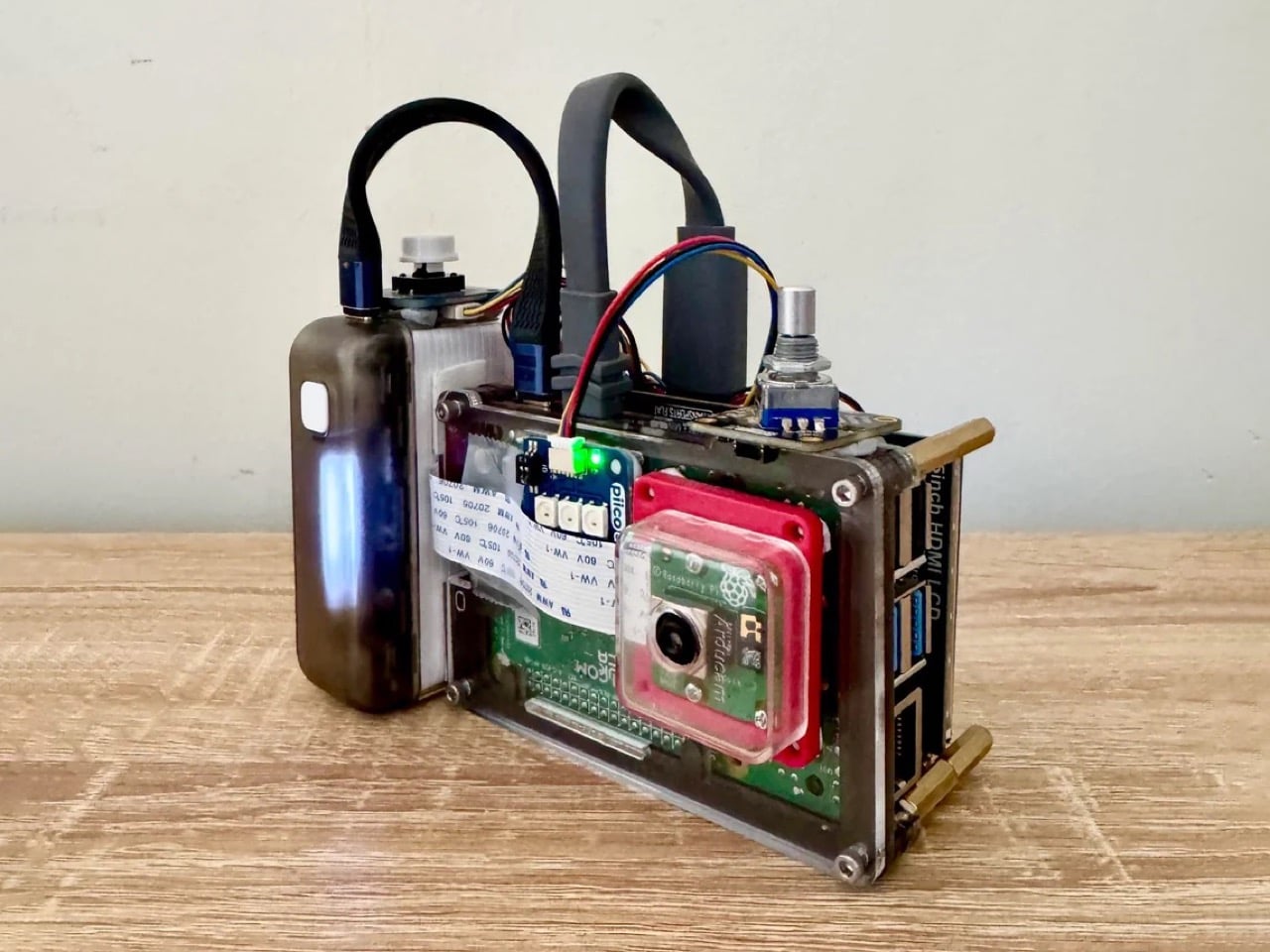
"You currently have two options if you want to apply effects and filters to your photos: use an app that will inevitably harvest your data for training their AI model (we're watching you, Instagram), or actually edit your photos manually, which requires time, software subscriptions, and the patience of a saint. Reddit user sharkbiscuit101 unlocked a third option, and it involves a Raspberry Pi 4, a rotary encoder, a gamepad, and a frankly unreasonable amount of ingenuity. The build produces glitch photography on the pixel level, in real time, through a custom script running entirely offline on hardware you can source yourself. No cloud upload, no terms of service, and crucially, no algorithm deciding what your creative output should look like."
"The camera itself works exactly how you'd want a dedicated glitch tool to work. Hit the shutter button, but before you do, twist the rotary dial to control how aggressively the Pi's script mangles the RGB channels of whatever you're pointing at. The result lands somewhere between a corrupted memory card and a fever dream, and the specific character of the glitch is entirely yours to tune through on-screen sliders before you commit to a shot. A small preview screen shows you the live feed so you can watch the image fall apart in real time, which is exactly as satisfying as it sounds."
"The rotary encoder also handles preset saves, so when you find a combination of settings that produces something genuinely beautiful and broken, you can lock it in and recall it later. The physical design is wonderfully unashamed about what it is. A transparent acrylic chassis sandwich holds the Pi 4 and an Arducam module at the center, with a small HDMI screen on the front face showing the preview, and a Adafruit gamepad breakout board mounted beside it for navigation. A Sharge battery pack, the rectangular kind you'd find at Amazon, clamps to the side and"
A Raspberry Pi 4 glitch camera applies real-time pixel-level effects to photos entirely offline. A rotary dial controls how aggressively the script mangles the RGB channels before the shutter is triggered. On-screen sliders allow tuning the glitch character, producing results between corrupted storage and surreal distortion. A live preview screen shows the feed as it breaks, enabling immediate creative feedback. Presets can be saved and recalled using the rotary encoder. The hardware uses a transparent acrylic chassis to hold the Pi 4 and an Arducam module, with an HDMI preview display and a gamepad breakout board for navigation. A battery pack powers the build for standalone use.
Read at Yanko Design - Modern Industrial Design News
Unable to calculate read time
Collection
[
|
...
]