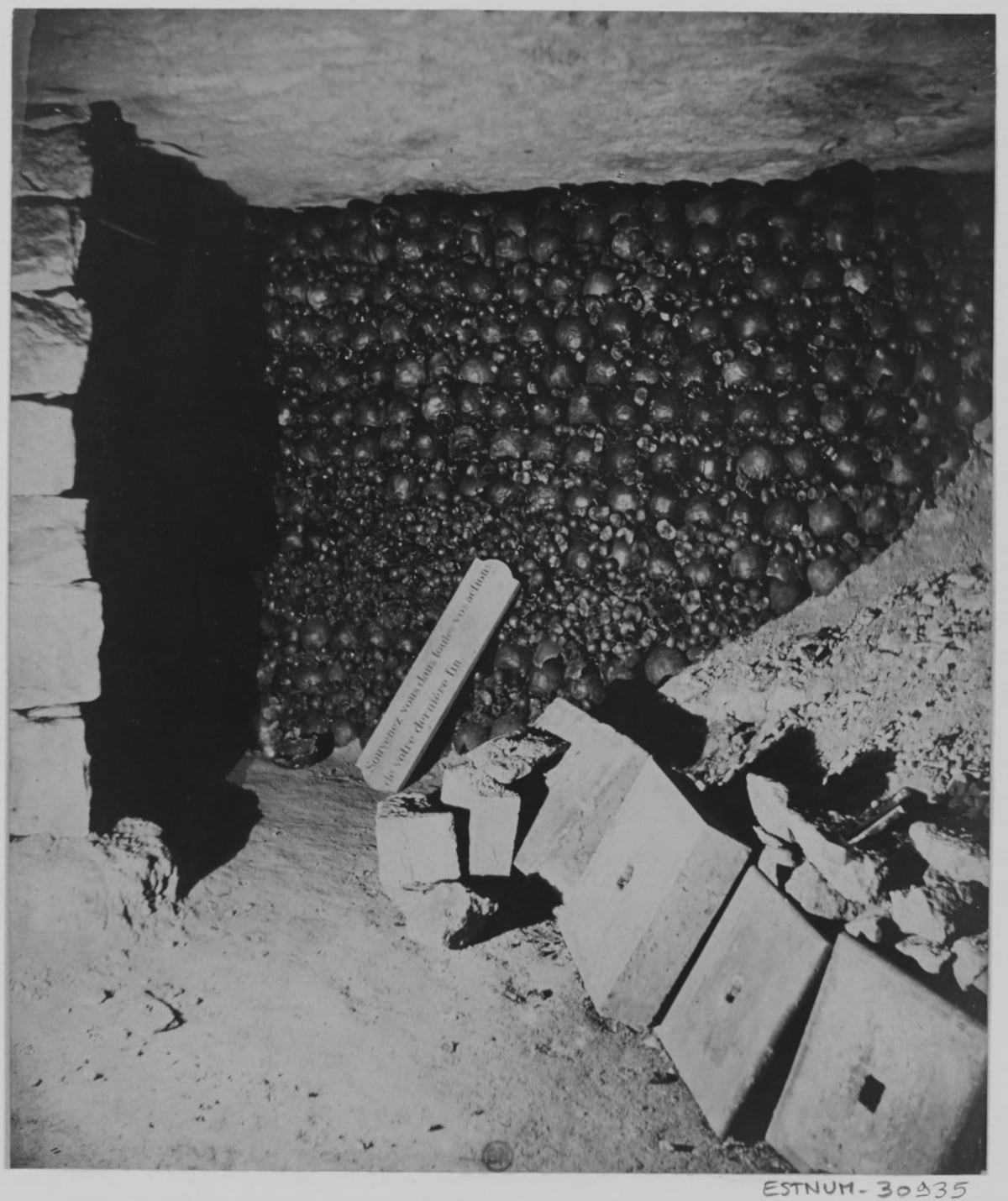
"In 1861, the photographer Felix Nadar historically immersed himself in the catacombs of Paris, the vast network of tunnels in which rest the remains of some six million people. Used as an ossuary since the end of the 18th century, it makes use of the nearly 190 miles of galleries below the capital resulting from limestone extraction. In so doing, it put an end to problems with the over-saturation of cemeteries (in addition to their foul odors, the city was still expanding), and Napoleonic France repurposed the morgue into a monumental work of funereal art, opening it to the public in 1809."
"Under the tutelage of the engineer Hericart de Thury, who decorated and designed its walls with rows of bones, symbols and plaques indicating their cemetery of origin, the catacombs are replete with literary inscriptions, presided over by the Dantesque Stop! This is the Empire of the Dead at its entrance in the city's 14th arrondissement, the official start of its tours. The mannequin used by Felix Nadar, representing the passage of a cart bearing human bones through the galleries."
"Nadar obtained this unusual permission in order to carry out an experiment with artificial light. The shocking results from his sessions were just compiled in a book from Spanish publisher La Felguera, Catacumbas. Exploradores y fotografia espectral en las catacumbas de Paris (Catacombs: Explorers and spectral photography of Paris), in which the photographer's black-and-white images alternate with testimonies from renowned visitors of different eras, from Spanish dramatist Jose Echegaray to British writer Robert Macfarlane."
"When Nadar came up with it, no one believed in the project. But he accomplished a real feat, because it was the first time that darkness was photographed, the book's publisher Servando Rocha tells EL PAIS. Imagine how much time this man spent down there, practically alon"
Paris catacombs contain the remains of about six million people in nearly 190 miles of tunnels formed from limestone extraction. The site was repurposed from an ossuary and morgue to address cemetery overcrowding and odors, and it opened to the public in 1809. Engineer Hericart de Thury decorated the walls with bones, symbols, and plaques indicating the cemeteries of origin, along with literary inscriptions. Felix Nadar received permission to conduct an experiment with artificial light and created black-and-white images of the catacombs. The results were later compiled in Catacumbas: Exploradores y fotografia espectral en las catacumbas de Paris, alternating photographs with testimonies from notable visitors. The work is described as the first time darkness was photographed.
Read at english.elpais.com
Unable to calculate read time
Collection
[
|
...
]