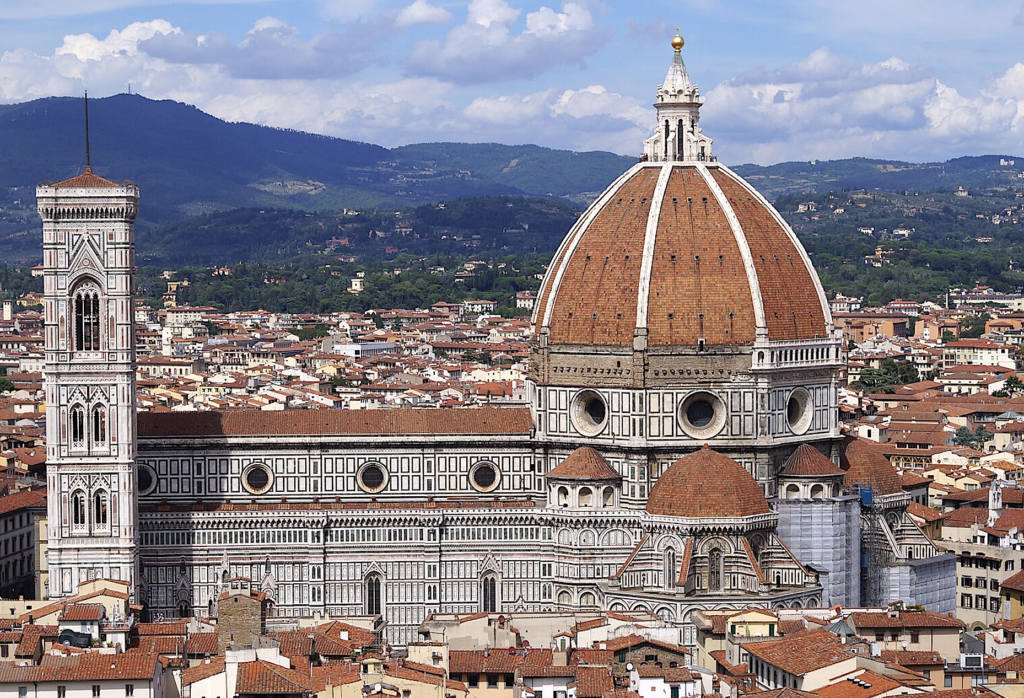
"No one who trav­els to Flo­rence can help see­ing the dome of the Cathe­dral of Saint Mary of the Flower. That's true not just because of its sheer loom­ing phys­i­cal pres­ence over the rest of the city, but also because of its impor­tance as an achieve­ment in var­i­ous kinds of his­to­ry, from that of engi­neer­ing to archi­tec­ture to reli­gion. Its sto­ry is told by art his­to­ri­ans Beth Har­ris and Steven Zuck­er in their new Smarthis­to­ry video above, which begins in the year 1417."
"At the time, Zuck­er explains, Flo­rence had a "huge" prob­lem: the ground­work for its ambi­tious­ly large cathe­dral had been laid a cen­tu­ry before, but nobody knew how to build the dome for which its plans called. The assump­tion, says Har­ris, was that "by the time they had to build it, they would fig­ure out how to do it," a reflec­tion of both the more relaxed speed of con­struc­tion in the fif­teenth cen­tu­ry, as well as a pace of inno­va­tion."
"Such a struc­ture had­n't been built since the Pan­theon in antiq­ui­ty, the out­do­ing of which would, at least in the­o­ry, con­firm Florence's recep­tion of the torch of civ­i­liza­tion from Rome. But none of the tra­di­tion­al tech­niques could sup­port a dome of this size, atop so high a tow­er, dur­ing con­struc­tion. Sal­va­tion even­tu­al­ly came in the unpromis­ing form of Fil­ip­po Brunelleschi, an archi­tect, sculp­tor, and gold­smith with­out much of a résumé - but, cru­cial­ly, with a deep under­stand­ing of the Pan­theon."
Florence's cathedral dome dominates the city physically and symbolizes achievements in engineering, architecture, and religion. By 1417 the cathedral's groundwork had been laid a century earlier, but builders still lacked a method to construct the enormously large dome specified by the plans. Traditional techniques could not support a dome of that scale atop such a high tower during construction, and the only architectural precedent of comparable ambition dated to the Pantheon in antiquity. The fifteenth-century climate of relaxed construction pace and rapid innovation enabled a practical solution. Filippo Brunelleschi, an architect, sculptor, and goldsmith with deep knowledge of the Pantheon, provided the engineering innovations that made the dome possible.
Read at Open Culture
Unable to calculate read time
Collection
[
|
...
]