"“In the previous generation, if you sat around your apartment long enough, you started to go stir crazy, and that would often compel people to go out,” he said. He said that homes have become entertainment bunkers that let Americans stream, scroll, get directions, and find recommendations without knocking on a neighbor's door. While independence is “empowering” there's a “pernicious element too... It's sort of changing the culture around what we can expect from each other and particularly our neighbors,” Cox said."
"“Young people are also more likely to live in new cities, live among strangers and frequently relocate. Whereas someone who's lived in the same community for decades has years to build relationships.” Cox said young Americans also talk less with neighbors because they have less practice with face-to-face connections during their formative years."
"He noted that young people who grew up in the pandemic or entered the workforce as remote employees missed out on the everyday interactions that build confidence and community. “When we deny young people these opportunities, we can't expect them to learn this stuff on their own,” Cox said. He added that regular religious attendance drives community connection across all denominations, and research shows Gen Z is increasingly less religious than older generations."
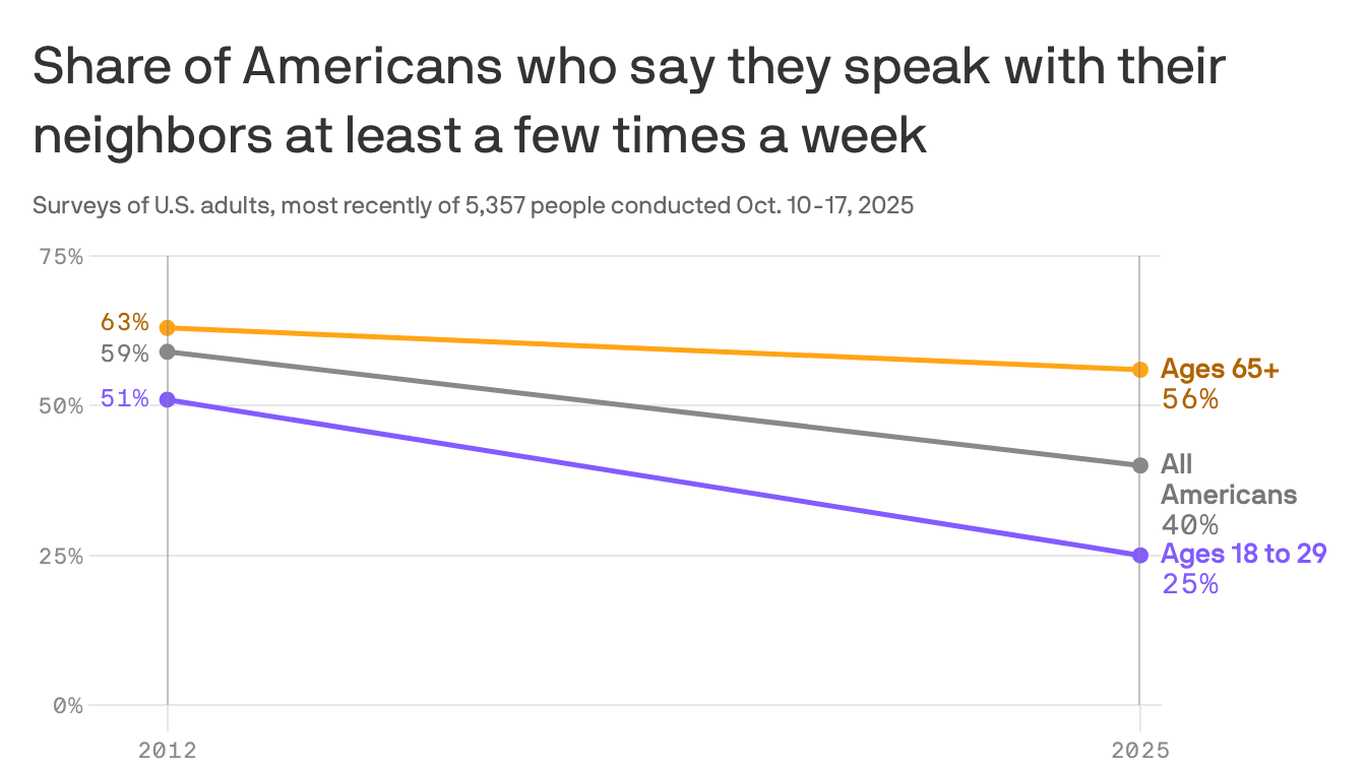
In 2012, 51% of young Americans regularly engaged with neighbors, falling to 25% by 2025. Among seniors, 56% socialize with neighbors, down seven points since 2012. Overall, 59% of Americans chatted with neighbors a few times per week in 2012, dropping to 41% in 2025. Technology is cited as a factor because homes function as entertainment and information hubs that reduce the need to go out and interact. Young people are also more likely to live in new cities, among strangers, and relocate frequently, limiting relationship-building time. Reduced face-to-face opportunities during formative years, including pandemic-era disruptions and remote work, further weakens confidence and community formation. Regular religious attendance is linked to community connection, while Gen Z shows lower religious participation than older generations. Digital communities are increasingly replacing in-person neighbor ties.
#neighbor-socializing #technology-and-social-behavior #youth-and-community-ties #remote-work-and-pandemic-effects #religious-attendance-and-community
Read at Axios
Unable to calculate read time
Collection
[
|
...
]