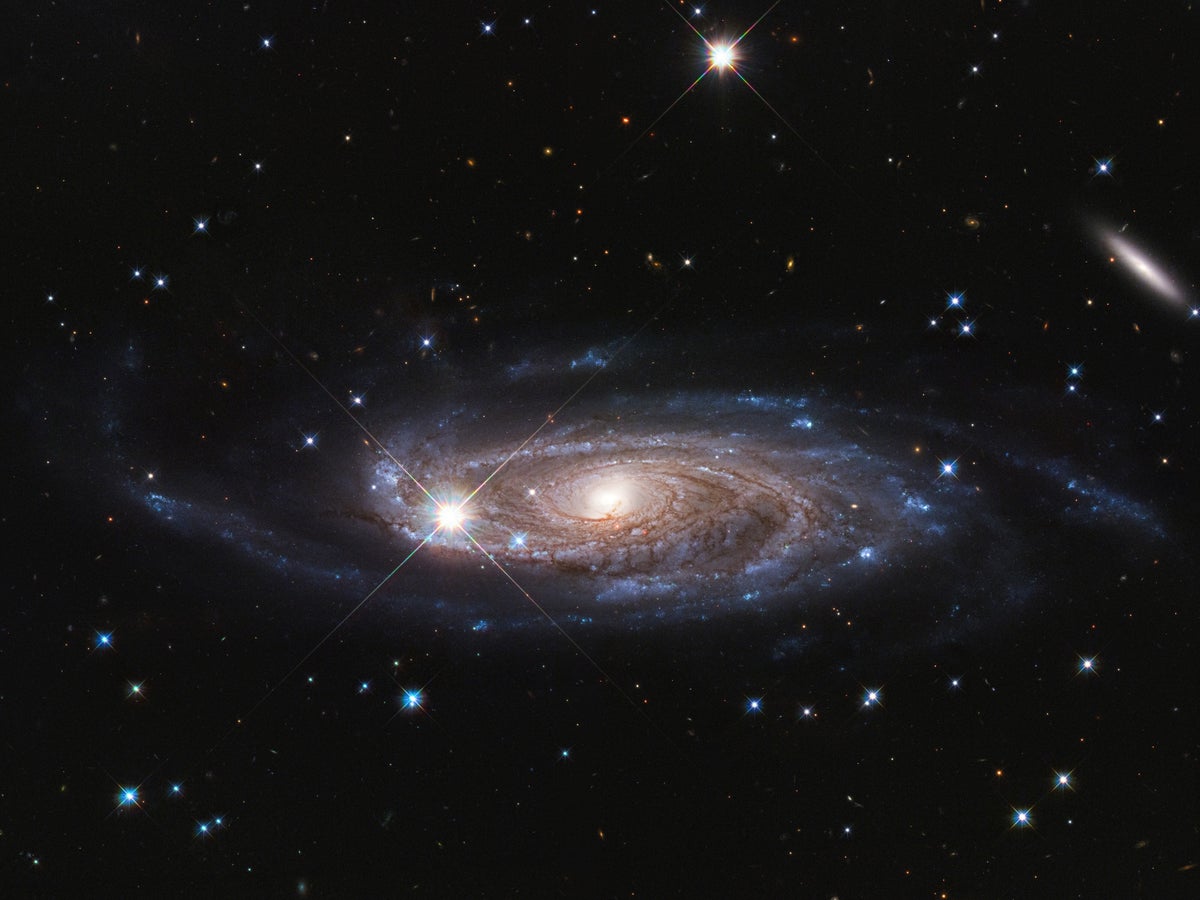
A galaxy is commonly described as stars, gas, dust, and dark matter held together by mutual gravity, but real systems vary widely. Some galaxies contain little dark matter, some have little or no gas and dust, and some have very few stars. Small galaxies can resemble globular clusters, such as Omega Centauri, which may have begun as a small galaxy and later lost stars through an encounter with the Milky Way. Defining galaxy size is also difficult because galaxies do not have sharp edges. Stellar density thins with distance, producing fuzzy boundaries where stars blend into the foreground, complicating measurements of how large galaxies can be.
"Here's a hand-wavy attempt: a galaxy is a collection of stars, gas, dust and dark matter all held together by mutual gravity. That works for most galaxies but starts to get shaky when you look more closely. Some galaxies don't have much dark matter. Some have little or no gas and dust. Others barely have any stars! Perhaps worse, this definition is vague about size."
"At the lower end of the scale, some very small galaxies could be mistaken for globular clustersagglomerations of up to a few million stars that form alongside galaxies. The globular cluster Omega Centauri, for example, may have started out as a small galaxy before being stripped of many stars by an encounter with our own large spiral galaxy, the Milky Way."
"But what about the upper end of the scale? How big can a galaxy get? The maddening answer is that no one really knows. The Milky Way is pretty big as these objects go, with a starry disk at least 100,000 light-years across. Our galaxy, like most others we can examine in close detail, also has a much larger surrounding halo of hot, diffuse gas that's sprinkled with stars."
"But we'll leave halos out of this discussion because they're so hard to detect beyond our nearest galactic neighbors; instead, for determining width, let's stick to a galaxy's more luminous and star-rich regions. But even then it's difficult. Galaxies lack distinct edges like those of rocky planets or moons. Instead a galaxy's distribution of stars thins out farther from the center. That attenuation makes for fuzzy boundariesall the more so because as a galaxy's stars get less numerous with distance, they blend into the foregrou"
Read at www.scientificamerican.com
Unable to calculate read time
Collection
[
|
...
]