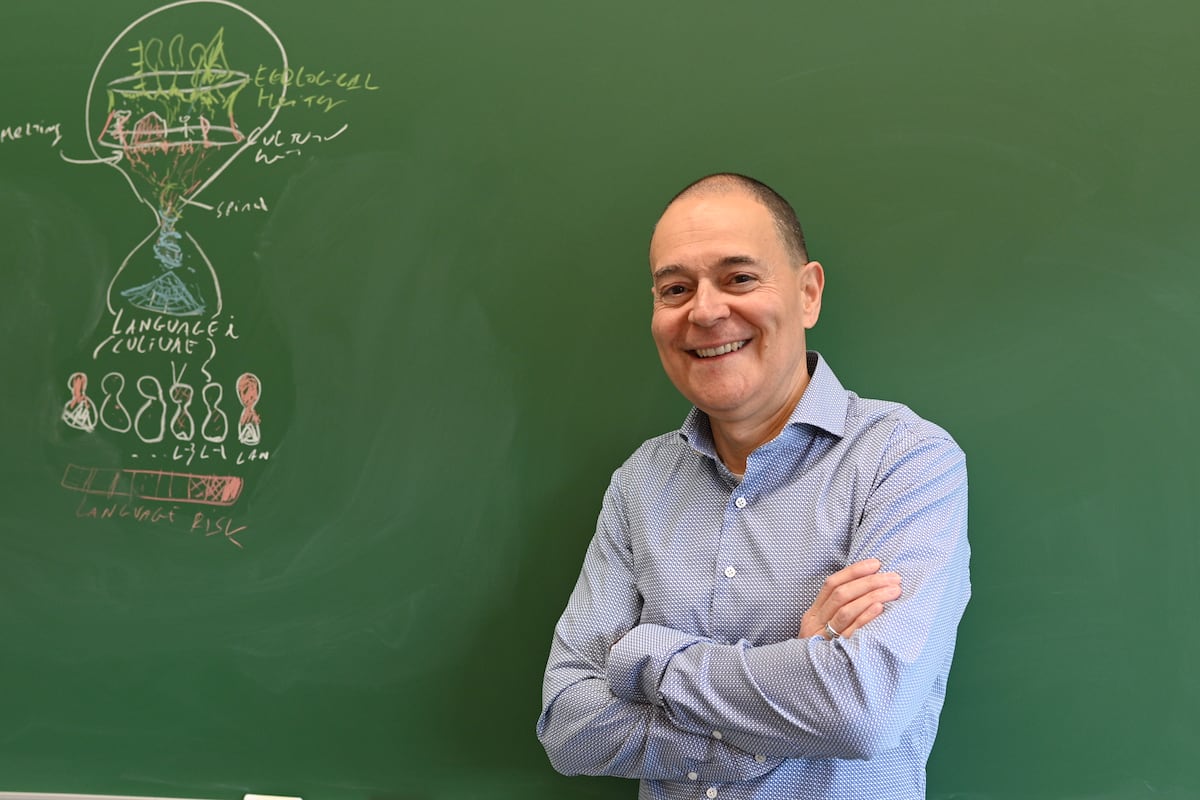
Four researchers—Jordi Bascompte, Bartolo Luque, Fernando Ballesteros, and Enrique Muro—received the Cozzarelli Prize for their groundbreaking study on the evolution of complex life. Beginning as doctoral students at the Polytechnic University of Catalonia, Bascompte and Luque exchanged problems across biology and physics disciplines. Their research addressed a fundamental question: if life followed its initial trajectory, only microbes would exist today. The study identified a crucial, non-contingent transition point in evolution that was previously undefined. This interdisciplinary approach, combining biology, physics, and computing, proved essential for solving the problem. The Cozzarelli Prize, awarded annually by the U.S. National Academy of Sciences, recognizes the best research across six scientific categories. This marks only the second time Spanish researchers have received this honor.
"The problem lies at the heart of the evolution of life, but the solution was only possible through physics and computing. Frontier science, where different fields intersect, is very fruitful, but unfortunately, not many people are doing it."
"If life on Earth had followed its initial course, today there would be no humans, no animals, no plants, no complex life forms; only microbes. In that scenario, not everything could be left to chance; there had to be a necessary step, a decisive transition that no one had yet been able to define."
#evolution-of-complex-life #interdisciplinary-research #cozzarelli-prize #abiogenesis-and-transition #physics-and-biology-collaboration
Read at english.elpais.com
Unable to calculate read time
Collection
[
|
...
]