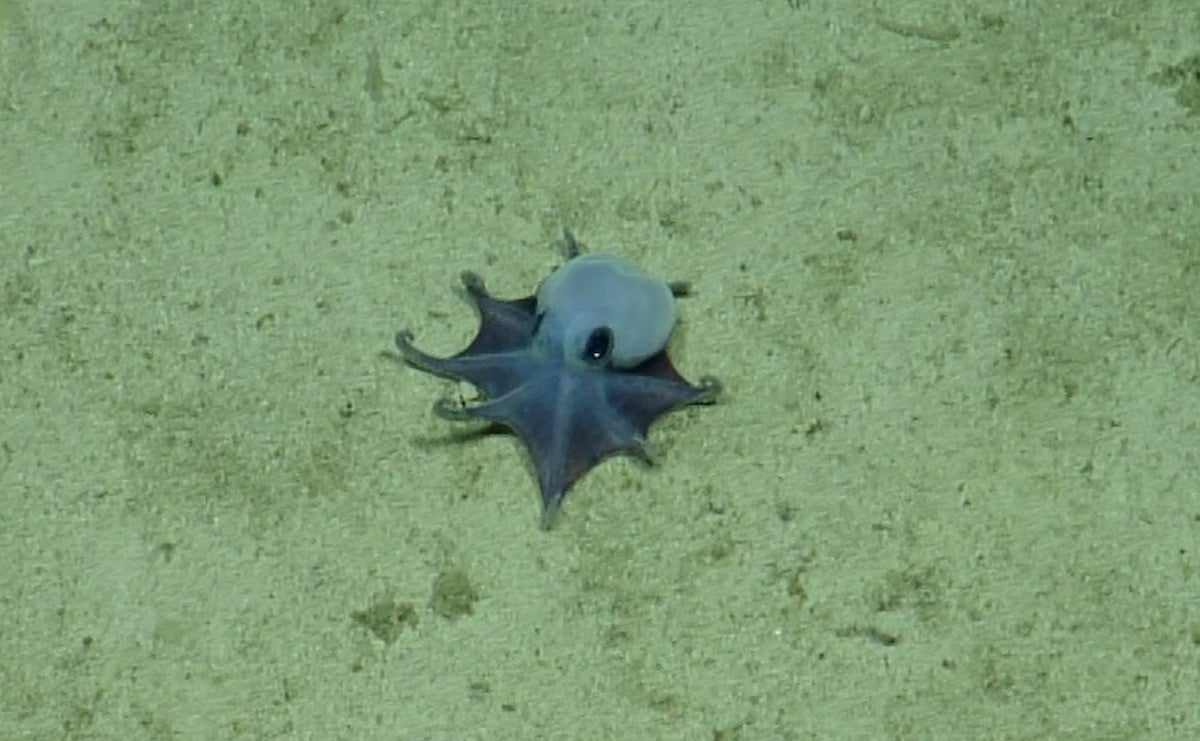
A golf ball-size blue octopus was discovered on the deep seafloor off the Galapagos Islands during a 10-day Pacific expedition. Researchers launched a robotic sub, Hercules, near Darwin Island and found the octopus on an underwater mountainside about 1,773 meters below the surface. Specimens were collected for analysis at the Charles Darwin Research Station, but the animal could not be identified initially. An image was sent to octopus expert Janet Voight, who recognized it as something special. Micro-CT scanning produced high-resolution virtual models of internal organs, revealing features such as few suckers, smooth skin, beak characteristics, and distinctive coloration. The octopus was named Microeledone galapagensis.
"A golf ball-size octopus found on the deep seafloor off the Galapagos Islands is an entirely new species, scientists just announced. In July of 2015, during a 10-day expedition in the Pacific Ocean, researchers aboard the E/V Nautilus launched a robotic sub called Hercules just off the coast of Darwin Island, part of the Galapagos archipelago. On an underwater mountainside some 1,773 meters below the sea's surface, they discovered a little blue octopus."
"After collecting some specimens to analyze back at their lab at the Charles Darwin Research Station, the scientists realized they couldn't identify the blue cephalopod. They sent an image to octopus expert Janet Voight, curator emerita of invertebrates at the Field Museum in Chicago. Right away, I knew it was something really special, said Voight, lead author on a new paper describing the find published in Zootaxa, in a statement. I'd never seen anything like it."
"The team looked at the octopus's internal organs using micro-CT scanning, which collects thousands of x-ray image slices through an object that can then be put together to create a super high-resolution virtual model. Details such as the relatively few suckers on its arms, its smooth skin, beak features and the coloring around its organs and parts of the mantle indicated a new species, now called Microeledone galapagensis."
Read at www.scientificamerican.com
Unable to calculate read time
Collection
[
|
...
]