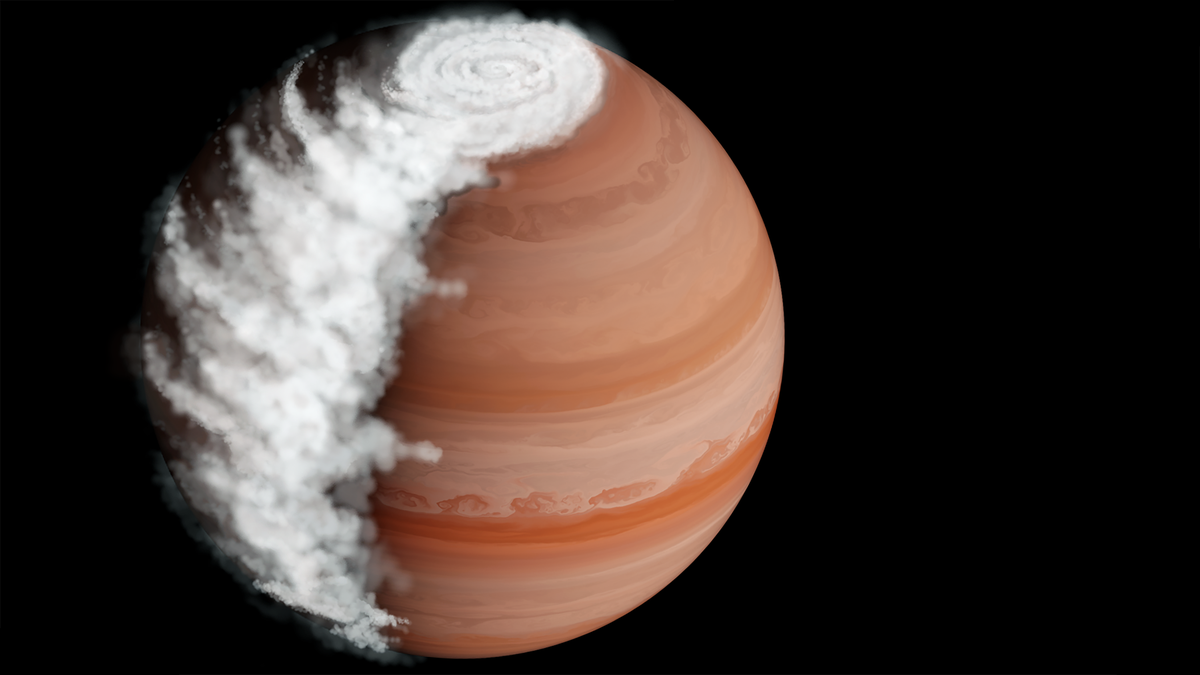
WASP-94A b is a hot Jupiter about 700 light-years away that orbits its star every four days. Its mass and orbital period are inferred from the star’s wobble, and its size and atmospheric composition are studied through transits that slightly dim starlight. During transits, spectra of starlight passing through the planet’s upper atmosphere reveal chemical presence or absence, but clouds can block these measurements. The planet’s tidal locking creates permanent day and night hemispheres, allowing observations of the leading morning side and trailing evening side separately as the planet moves. This separation enables clearer atmospheric characterization despite cloud interference.
"Nearly 700 light-years from Earth, morning clouds make way for a clear night on the exoplanet WASP-94A b. Scientists discovered this gas giant more than a decade ago, but new observations from NASA's James Webb Space Telescope (JWST) offer this weird world's first-ever weather report."
"Carefully monitoring the star for these transits allows astronomers not only to measure WASP-94A b's size but also to study its composition, sniffing out the presence or absence of various chemicals in its air by gathering spectra from starlight streaming through the gas giant's upper atmosphere. Dense starlight-blocking clouds, however, can often obscure such spectral observations."
"But researchers realized WASP-94A b offered a potential work-around. The planet is held so close by its star that it has become tidally locked, much like the moon around Earth: the exoplanet's spin and its orbit is synchronized so that the world always turns the same side to its stellar host. This results in eternal day for one half of the planet and eternal night for the other."
"But it also lets astronomers view the edges of these halvesthe leading morning side and the trailing evening sideseparately as WASP-94A b moves around its star. On supporting science journalism If you're enjoying this article, consider supporting our award-winning journalism by subscribing. By purchasing a subscription you are helping to ensure the future of impactful stories about the discoveries"
Read at www.scientificamerican.com
Unable to calculate read time
Collection
[
|
...
]