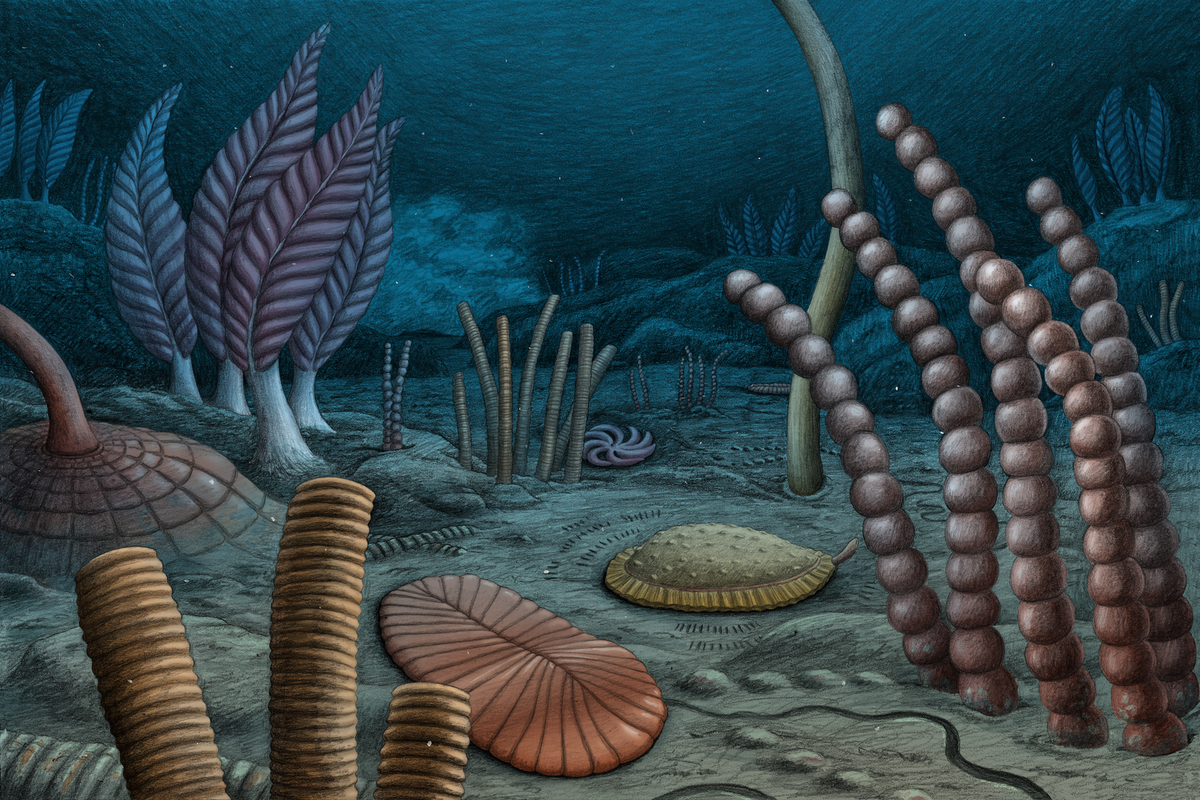
Snow-covered peaks in Canada’s Northwest Territories preserve an ancient seafloor from more than half a billion years ago. Researchers collected over 100 fossils of soft-bodied organisms in the MacKenzie Mountains, providing a rare view into the Ediacaran period before the Cambrian explosion. Many fossils appear as detailed imprints on slabs of mud-colored rock. Compared with earlier Ediacaran finds, the new specimens look more like familiar animals, including organisms that moved and some that reproduced sexually. Dickinsonia is described as a frisbeelike form without a mouth that absorbed algae through its underbelly. Kimberella is described as a teardrop-shaped creature.
"Found in the MacKenzie Mountains in Canada, the new fossils provide a rare window into the Ediacaran, a geological period that precedes the Cambrian explosion of biological diversity. To reach the site, study lead author Scott Evans, a paleontologist at the American Museum of Natural History, and his colleagues embarked on a 14-hour drive and a helicopter flight. One of the site's fossils of Dickinsonia, an early complex organism that absorbed bacteria and algae as it moved along the seafloor."
"In total, the team collected more than 100 fossils of strange, soft-bodied creatures that record major milestones in the evolution of life as we know it. Compared with finds from earlier in the Ediacaran, these fossils look a little more like animals that we're familiar with, Evans says. They move around, and some of them are reproducing sexually."
"But the fossils, many preserved as detailed imprints on slabs of mud-colored rock, were worth the journey. The new fossils, described today in the journal Science Advances, also suggest that the deep sea served as an environmental cradle for complex life. Found in the MacKenzie Mountains in Canada, the new fossils provide a rare window into the Ediacaran, a geological period that precedes the Cambrian explosion of biological diversity."
"Among these early movers were the frisbeelike Dickinsonia, which lacked a mouth and hoovered up algae through its underbelly, and Kimberella, a teardrop-shaped creature that scra"
#ediacaran-period #early-complex-life #fossil-discovery #deep-sea-environments #evolutionary-biology
Read at www.scientificamerican.com
Unable to calculate read time
Collection
[
|
...
]