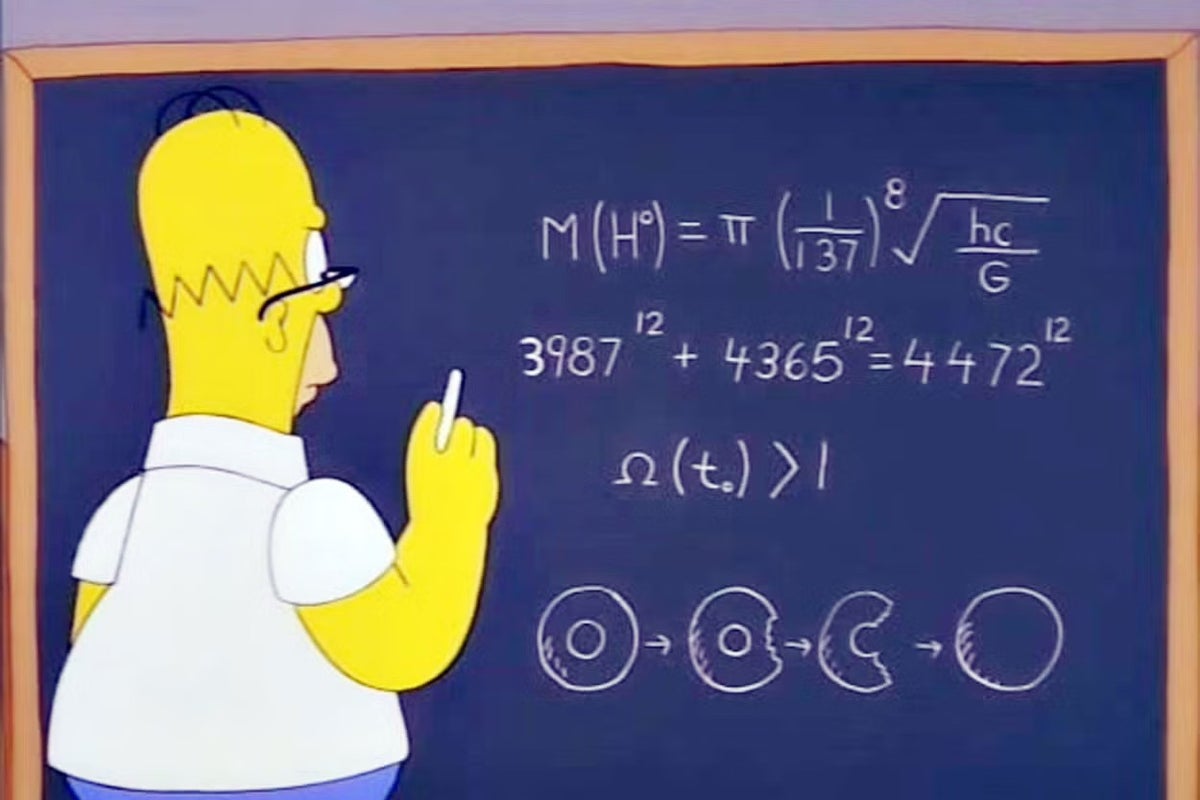
"In one particular scene, Homer stands pensively at a fully scribbled blackboard. Next to the obligatory drawings of doughnuts, there is a seemingly harmless equation: 3,98712 + 4,36512 = 4,47212. Type it into a calculator and it appears correct. But amazingly, it contradicts one of the most established theorems of mathematics."
"This story dates back to the 17th century. It starts with the equation xn + yn = zn. If you choose n = 1, then this equation will always be satisfied: no matter how one chooses the values for x and y, z will always be a positive integer result."
In The Simpsons episode 'The Wizard of Evergreen Terrace', Homer grapples with a midlife crisis and attempts to emulate Thomas Edison. A notable scene features a blackboard equation that seems valid but contradicts Fermat's Last Theorem. This theorem, established in the 17th century, states that no three positive integers can satisfy the equation xn + yn = zn for n greater than 2. The episode cleverly incorporates mathematical concepts, highlighting the intersection of popular culture and mathematics.
Read at www.scientificamerican.com
Unable to calculate read time
Collection
[
|
...
]