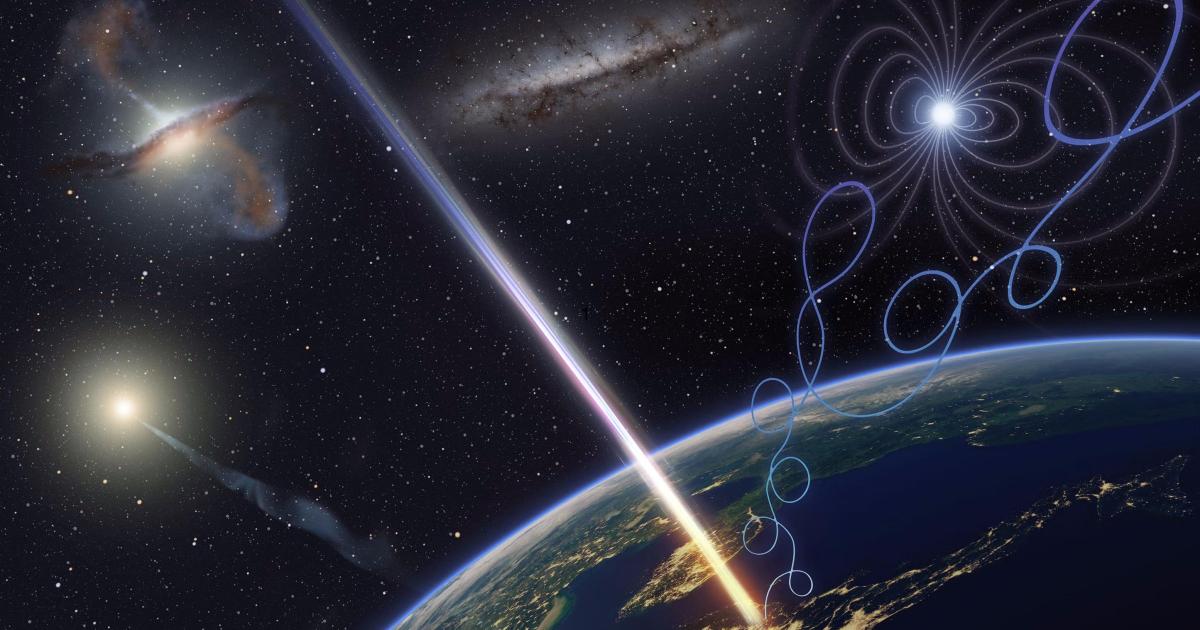
"Earth, whether we like it or not, serves as a cosmic particle detector on a continuous basis. It isn't just light waves that travel through the Universe, nor is that light merely joined by gravitational waves and ghostly neutrinos. In truth, cosmic particles and antiparticles of all types are produced in high-energy processes throughout the Universe, from the Big Bang to stars to white dwarfs to neutron stars to black holes, both large and small. When we put detectors up to detect what sorts of particles are out there, we find a virtual zoo, including:"
"Most cosmic rays, as we measure them, turn out to be protons, and just as you'd expect, there are more of them at lower energies and fewer and fewer of them as you look to ever-higher energies. However, there's a theoretical limit to how energetic even the highest-energy cosmic rays ought to be: about 50 exa-electron-volts (50 EeV, or 5 × 10 19 electron-volts), a limit known as the GZK cutoff."
Cosmic rays consist of a wide variety of particles and antiparticles produced by high-energy processes across the Universe, from the Big Bang to compact objects. Measured cosmic-ray populations are dominated by protons, with abundance decreasing as particle energy increases. A theoretical upper energy limit for cosmic rays exists near 50 exa-electron-volts, called the GZK cutoff. Observations have recorded rare events far above that limit, such as a 320 EeV event in 1991 and a 240 EeV event in 2021. The generation of cosmic rays depends on energetic environments where large numbers of particles are concentrated.
Read at Big Think
Unable to calculate read time
Collection
[
|
...
]