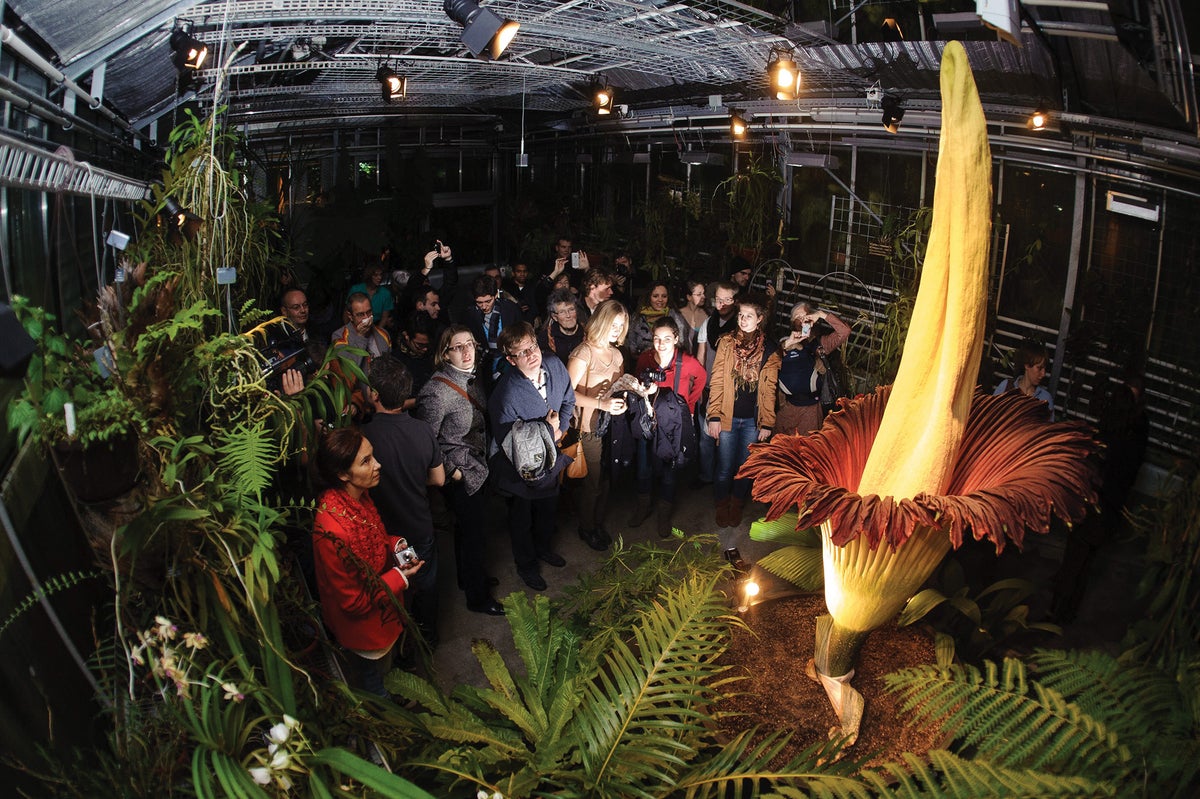
"A pale spike resembling the decaying finger of a buried giant pushes up from the earth until it towers 10 feet above the ground. A massive petal-like structure unfurls to form a blood-red cape around the finger. The smell of rotting flesh fills the air. Then, some 36 hours later, the bloom is over."
"At any given time, botanical gardens, arboretums and nurseries around the world are making plans to share news about their specimen. They don't know exactly when it will bloom—the titan arum works on no one's schedule but its own—but they need to be ready when it does: this species, Amorphophallus titanum, often brings in more traffic to botanical institutions than any other species in their collections."
"Scientific interest in this monstrosity dates back to at least the late 1800s, when Italian botanists first formally described the species, which is endemic to the rainforests of western Sumatra. Researchers have been studying this floral phenomenon ever since."
The titan arum is a remarkable plant species endemic to Sumatran rainforests that produces one of nature's most spectacular and unusual blooms. The flower features a pale spike reaching 10 feet tall surrounded by a blood-red petal-like structure, accompanied by a strong odor of rotting flesh. The bloom lasts only 36 hours, with blooming cycles occurring seven or more years apart. Botanical institutions worldwide prepare extensively for blooming events, as the corpse plant attracts more visitors than nearly any other species in their collections. Scientific interest in this plant dates back to formal descriptions by Italian botanists in the late 1800s. Researchers continue studying the corpse flower's evolutionary history and unique characteristics.
Read at www.scientificamerican.com
Unable to calculate read time
Collection
[
|
...
]