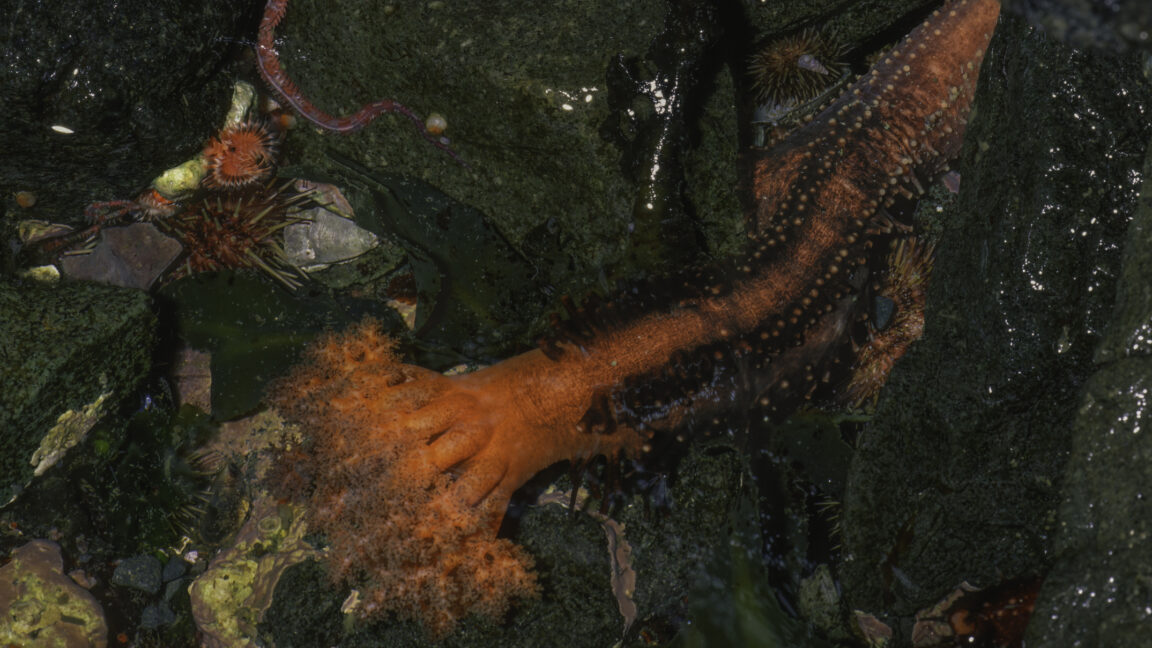
Organs and complex tissues typically decay quickly after separation from a host, and maintaining them alive usually requires germ-free conditions and nutrient-rich media with growth factors. Tissue fragments from the sea cucumber Psolus fabricii can keep living indefinitely when left in ordinary seawater. The species lives in cold Atlantic and Arctic waters and uses a soft sole with tube feet to grip rocks, while extending branching tentacles to feed. High injury and loss rates in its feet and tentacles have driven strong regenerative capacity. Although it does not regenerate whole bodies from severed pieces, amputated tissue does not die and continues healing and surviving without special handling.
"Organs, arms, appendages, and other complex tissues usually decay rapidly when they're separated from their host. Over the years, biologists have seen some success with keeping them alive outside of the body-organ transplants depend on it-but it has always required germ-free environments and nutrient-rich mediums filled with growth factors. Now, though, scientists have discovered bits of tissue removed from a species of sea cucumber called Psolus fabricii can keep on living indefinitely if they're left in ordinary seawater."
""This is naturally occurring tissue immortality," said Sara Jobson, a researcher at Memorial University of Newfoundland and lead author of the study. "Having tissues that survive that easily is unheard of. We've never seen anything like this.""
"Psolus fabricii is a species of sea cucumber that lives in the cold waters of the Atlantic and Arctic oceans. Its bottom side, known as a sole, is soft and ringed by a band of tube feet that it uses to grip rocks. Once on a rock, it extends soft, branching tentacles into the water to feed on suspended particles. Because these sea cucumbers inhabit harsh environments, their feet and tentacles experience high rates of injury and loss. Evolution has therefore endowed these sites with an incredibly high capacity for regeneration."
"While sea cucumbers can easily regrow these parts, they don't have whole-body regeneration like flatworms and some starfish do. Their severed bits don't grow into new sea cucumbers. But it turns out they don't die, either. "We didn't set out to find immortal tissues," Jobson said. "Our lab focuses on sea cucumbers, and this sea cucumber has been used in other studies. One of my collaborators happened to notice that its amputated tissue just kept living, and it seemed to be healing and surviving and she didn't do anything special to keep it. It was a fortuitous dis""
Read at Ars Technica
Unable to calculate read time
Collection
[
|
...
]