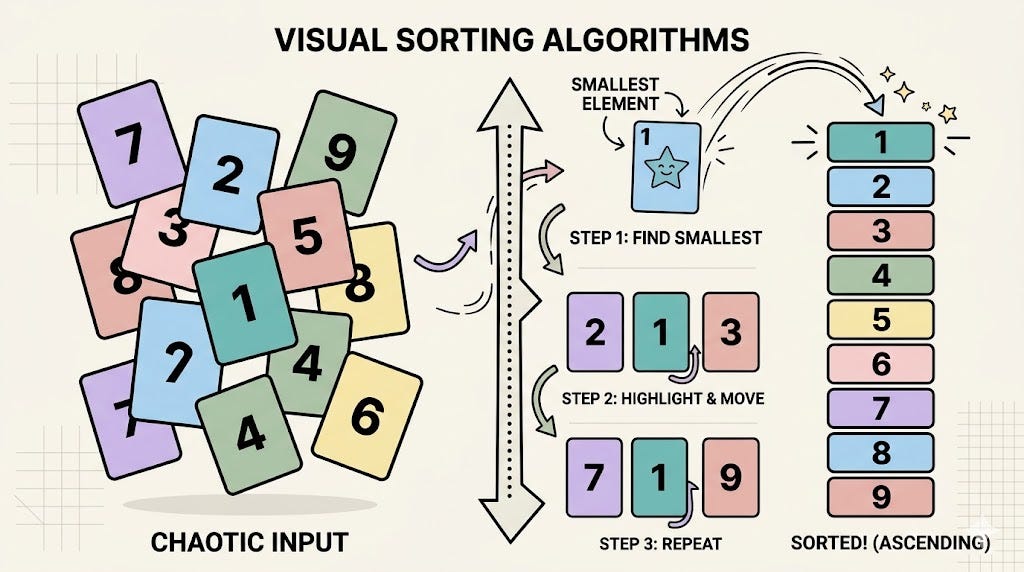
Selection sort can be understood as a simple everyday process: find the best candidate, place it where it belongs, and repeat. The data can be viewed as two regions, a sorted part and an unsorted part. Initially, the sorted region is empty and everything is unsorted. Each round scans the unsorted region to find the smallest value, swaps or moves it into the next position of the sorted region, and then never touches that position again. The algorithm continues until the unsorted region is exhausted, producing a fully sorted array from thinnest to thickest.
"Algorithms often sound more intimidating than they really are. Someone says sorting algorithm and many people immediately imagine: scary computer science lectures mathematical notation Big-O formulas everywhere complicated whiteboard interviews But most beginner algorithms are surprisingly ordinary once you strip away the terminology."
"Selection sort is a perfect example. Its entire strategy can be explained using something you already do naturally in everyday life: find the best candidate, put it where it belongs, then repeat. That's all. No magic. No hidden computer science ritual. Let's make it visual."
"Selection sort quietly divides your array into two invisible regions. Think of the data as having two zones: Sorted Part | Unsorted Part At the beginning: Nothing is sorted yet. Everything belongs to the unsorted zone. Each round follows the same pattern: Simple. Predictable. Repeatable."
"Each round follows the same pattern: Simple. Predictable. Repeatable. Let's sort this array: const values = [64, 25, 12, 22, 11]; Current state: Search for the smallest value. Scan through everything: Smallest value: Move it to the front. Result: The first slot is finished forever. We never need to touch it again."
Read at Substack
Unable to calculate read time
Collection
[
|
...
]