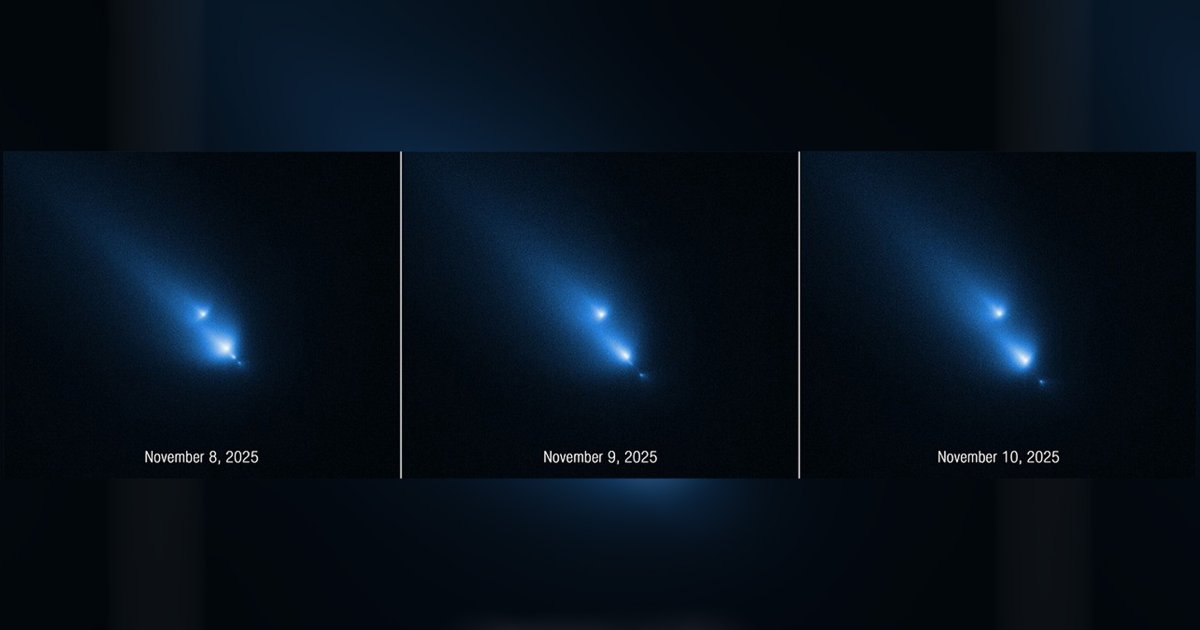
""Sometimes the best science happens by accident," John Noonan stated, highlighting the unexpected nature of the discovery when the comet began breaking apart during observations."
""Right when we observed it, it happened to break apart, which is the slimmest of slim chances," Noonan explained, emphasizing the rarity of the event."
"As principal investigator Dennis Bodewits noted, the samples from the comet are usually not 'pristine,' making it difficult to draw broader conclusions about their implications."
"The fragments of C/2025 K1 each had a distinct coma, allowing scientists to infer the comet's composition and learn about the materials from the solar system's formation."
The Hubble Space Telescope captured the disintegration of comet C/2025 K1 (ATLAS) during observations from November 8 to November 20, 2025. This comet, which had recently approached the Sun, broke into four distinct fragments, each with its own coma. These observations allow scientists to analyze the comet's composition, offering insights into the materials from which the solar system formed. However, the fragments are not pristine due to heating and irradiation, complicating broader conclusions about planetary systems.
Read at Futurism
Unable to calculate read time
Collection
[
|
...
]