"The star's light output was nice and flat, but starting in 2016 it had these three dips in brightness. And then, right around 2021, it went completely bonkers. I can't emphasize enough that stars like our Sun don't do that. So when we saw this one, we were like 'Hello, what's going on here?'"
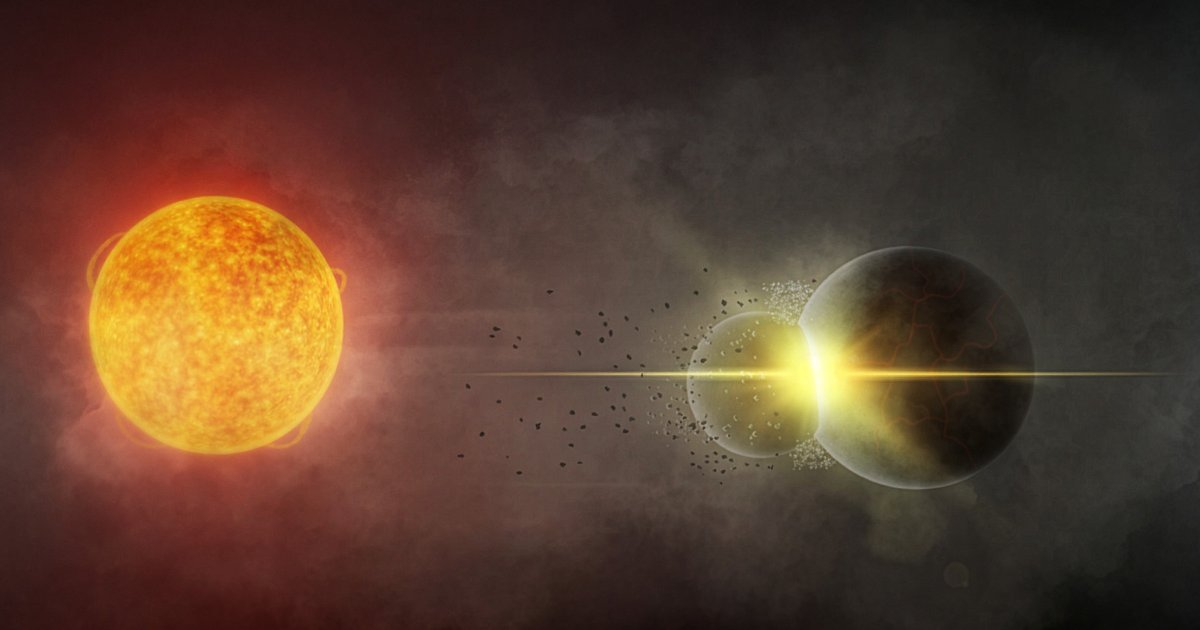
"The dark patches were caused by huge streams of rock and dust passing in front of it. The quantities would have to be enormous to even partially blot out starlight, so the astronomers say the most likely explanation was that they're the debris from a planetary collision."
"In the infrared data, the light curve spiked while the visible light dimmed. This could mean that the material blocking the star is hot - so hot that it's glowing in the infrared. A collision between two massive bodies would produce these levels of heat."
Astronomers identified evidence of a catastrophic planetary collision around the star Gaia20ehk by observing unusual brightness patterns. The star, initially stable like our Sun, began showing dramatic fluctuations starting in 2016 with three brightness dips, escalating dramatically by 2021. Massive streams of rock and dust passing in front of the star caused these dimming events. Infrared observations revealed the debris was extremely hot, glowing in infrared wavelengths while visible light dimmed. This combination of observations indicates two planets spiraled toward each other through grazing impacts before colliding catastrophically. The study provides insights into planetary evolution and collision mechanisms relevant to understanding our own solar system's formation and the Moon's origin.
Read at Futurism
Unable to calculate read time
Collection
[
|
...
]