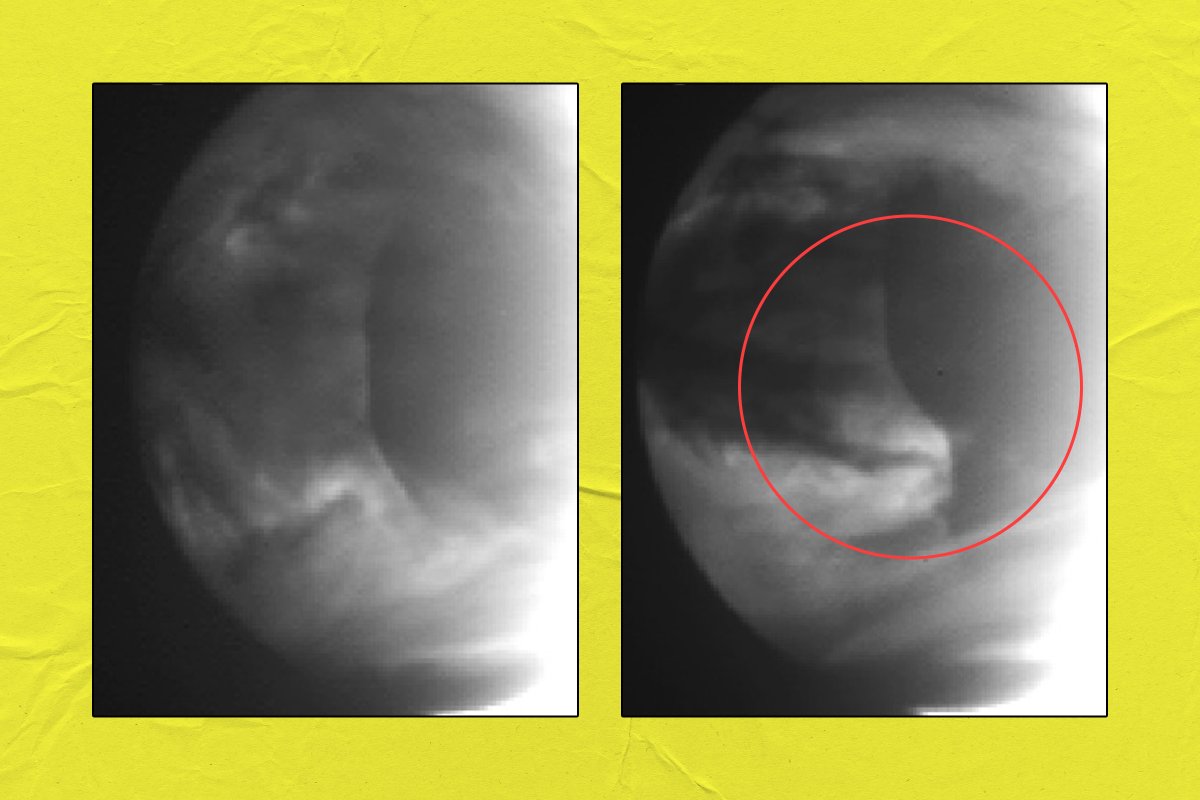
"When the Japanese Aerospace Exploration Agency's Akatsuki space probe visited the steaming hot world in 2016, it managed to spot something anomalous in the atmospheric veil obscuring the planet's inscrutable surface: an enormous wave tearing through the atmosphere for days at a time, creating a cloud that stretched up to 3,700 miles across. What possibly could've been responsible for this monstrosity was unclear."
"In a new study published in Journal of Geophysical Research: Planets, a team led by researchers from the University of Tokyo suggest that the atmospheric behemoth was spawned by turmoil in a lower cloud layer, in a phenomenon known as a "hydraulic jump" that burst to the surface. "We identified the phenomena, but for years we couldn't understand it," said lead author Takeshi Imamura at the University of Tokyo in a statement about the work."
""However, thanks to this research, we're now able to show that this cloud disruption is caused by the largest known hydraulic jump in the solar system." The Venusian atmosphere is primarily made of carbon dioxide, creating an extreme greenhouse effect that's responsible for the planet's hellish temperatures. Within this atmosphere are three distinct cloud layers. The clouds are composed of sulfuric acid, and their sheer celerity puts them in a class above Earth's."
"Unlike the ponderous, floating balls of cotton we associate with clouds on our planet, Venus' "superrotate," meaning they swirl around the planet 60 times faster than the planet itself turns. To astronomers, Venus's persistent and extreme clouds provide a way of probing fleeting atmospheric phenomena on Earth. But even by Venus's standards, a giant acid cloud bank thousands of miles across was extreme."
Akatsuki observed an anomalous, enormous atmospheric wave on Venus in 2016, producing a cloud up to 3,700 miles across and lasting for days. Researchers from the University of Tokyo proposed that the wave originated from turmoil in a lower cloud layer. The mechanism is a hydraulic jump, where disturbed flow transitions abruptly and bursts upward into the overlying atmosphere. Venus’s atmosphere is mostly carbon dioxide, creating an extreme greenhouse effect and very high temperatures. Venus has three distinct sulfuric-acid cloud layers that move much faster than Earth’s clouds due to superrotation, with winds swirling around the planet about 60 times faster than the planet’s rotation. This fast motion makes Venus cloud behavior useful for studying atmospheric dynamics.
Read at Futurism
Unable to calculate read time
Collection
[
|
...
]