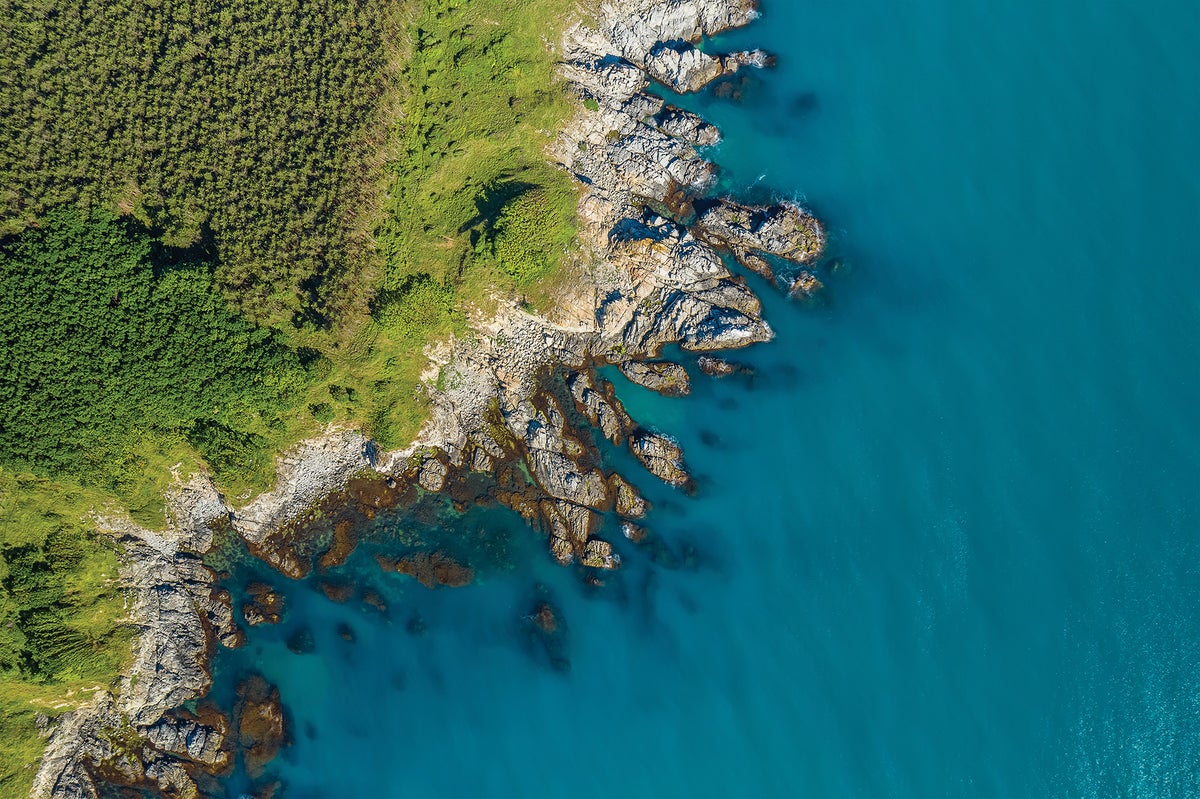
"Mandelbrot observed that the coastline of Great Britain is impossible to measureits perimeter gets longer the more closely you measure it. At that point he was eight years away from coining the term fractal: a shape containing smaller parts similar in shape to the larger whole that become apparent as you zoom in, creating an infinite, and infinitely complex, repeated pattern. Now the so-called coastline paradox he observed is one of many known examples of fractals in Earth's geography."
"The research, published on the preprint server arXiv.org and accepted in Geophysical Research Letters, stitches together geographic data for more than 130,000 of Earth's islands to show that although the landmasses behave like fractals in certain respects, the extent to which they do their fractal dimension differs depending on what geometric feature of the island you're looking at. Coastlines, researchers found, come in last (after, for instance, surface elevation)."
"A shape's fractal dimension tells you how much you can zoom in to keep the fractal pattern repeating. An island coastline with a low fractal dimension might look almost completely smooth, whereas one with a high fractal dimension will have a visibly bumpy, complex border even as you zoom in further. This concept extends to other geometric features of islands, including size distribution, elevation and volume."
Benoit Mandelbrot observed that the measured perimeter of Great Britain’s coastline increases as measurement resolution improves, motivating the idea of fractals. Recent research assembled geographic data for more than 130,000 islands to test how fractal properties vary across island geometry. Landmasses behave like fractals in some respects, but fractal dimension depends on which feature is measured. Coastlines show the lowest fractal dimension compared with other features such as surface elevation. This result conflicts with existing models that treat Earth’s surface as uniformly fractal. Fractal dimension indicates how much zooming preserves repeating structure, so low values correspond to smoother-looking borders while higher values correspond to more visibly complex ones. The same feature-dependent pattern applies to size distribution, elevation, and volume.
Read at www.scientificamerican.com
Unable to calculate read time
Collection
[
|
...
]