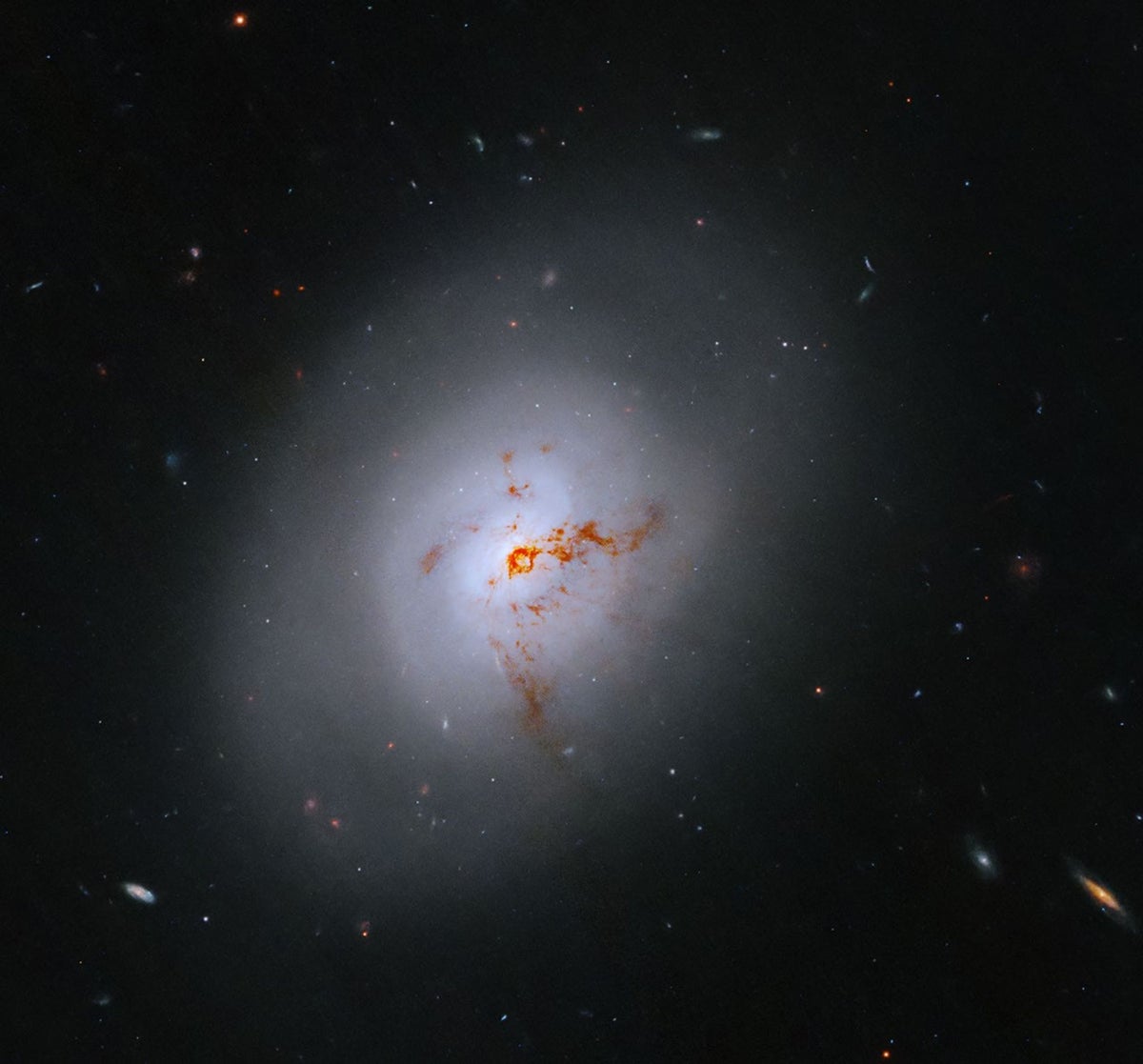
NGC 1266 is a lenticular galaxy about 100 million light-years away in Eridanus. It has a flattened, lenslike disk and a bright central bulge, resembling features of spiral galaxies, but it lacks spiral arms and shows little to no ongoing star formation like elliptical galaxies. Rusty-colored dust and gas partially obscure the galaxy in a new Hubble image. The stellar population appears relatively young, indicating the galaxy recently experienced a starburst phase that has since faded. Such transitional post-starburst galaxies are uncommon, with roughly one out of every 100 nearby galaxies in the Milky Way region fitting this category. The young stars likely formed after a collision with a smaller galaxy about 500 million years ago.
"Located 100 million light-years from Earth in the constellation Eridanus, the galaxy, called NGC 1266, is what's known as a lenticular galaxy. In a statement, NASA explained that these galaxies are viewed by astronomers as an evolutionary bridge between spiral galaxies such as the Milky Way and elliptical galaxies, which are known for having a shape like a stretched-out circle. NGC 1266 has the lenslike, flattened disk shape and bright central bulb of a spiral galaxy. But it has no spiral arms andlike an elliptical galaxyappears to have little to no ongoing star formation."
"In the new Hubble image, the galaxy can be seen partially obscured by rusty-colored clumps of dust and gas. While NGC 1266 may not be generating new stars, that wasn't the case in the not-too-distant past (relative to the age of the universe, at least). The stars in the galaxy appear to be relatively young, meaning NGC 1266 is a poststarburst galaxy."
"Just about one galaxy out of every 100 in the area near the Milky Way falls into this middle-aged category. The new image shows the galaxy NGC 1266, a middle-aged object with a clutch of young stars that likely collided with another, smaller galaxy 500 million years ago."
Read at www.scientificamerican.com
Unable to calculate read time
Collection
[
|
...
]