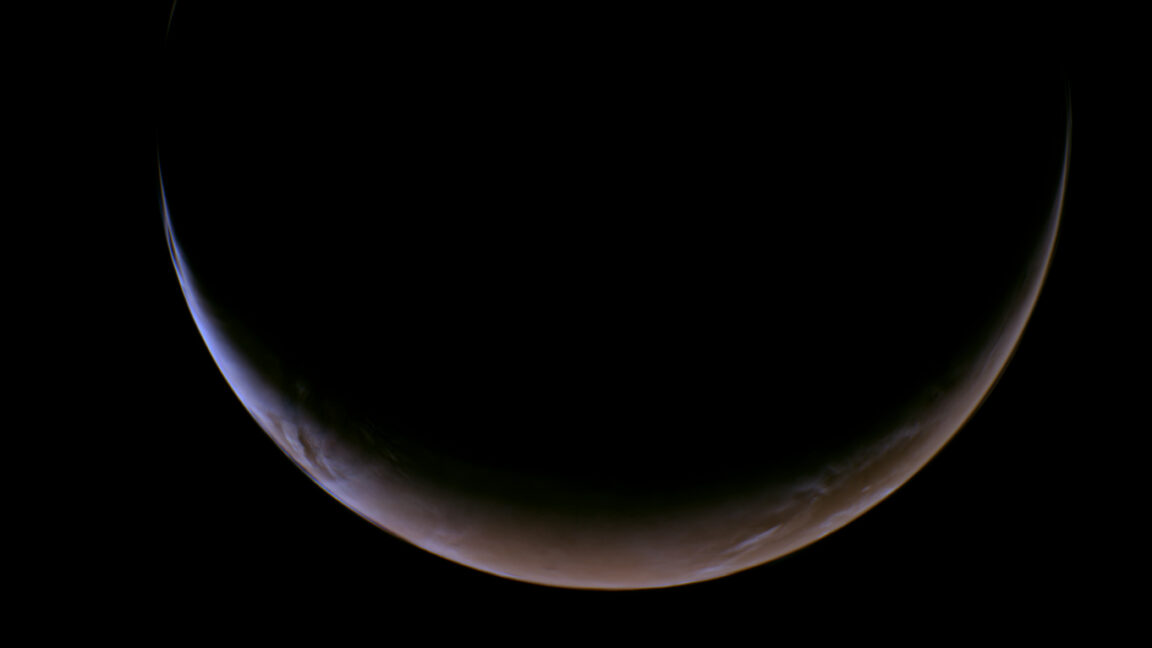
Psyche approached Mars from a high phase angle, viewing the planet as a thin crescent opposite the Sun. Thin Martian atmosphere and diffuse dust clouds were visible as sunlight shone through suspended dust dozens of miles above the rust-colored surface. During the flyby, cameras produced thousands of images, including a wide-angle overhead view of Mars’ southern polar ice cap. The magnetometer may have detected solar wind interactions with Mars’ upper atmosphere or remnant magnetic fields. Spectrometers were tuned to measure chemical composition of the Martian surface along the spacecraft’s path. Scientists plan to calibrate and characterize instruments by comparing flyby observations with archival data from other Mars missions. The main scientific payoff will occur in three years during the close approach to asteroid Psyche, which will be surveyed for over two years.
"The spacecraft approached Mars from a high phase angle, or from the side opposite the Sun, making the planet appear as a thin crescent as Psyche moved in for the encounter. The wispiness of the thin Martian atmosphere was on full display, with sunlight shining through diffuse clouds of dust suspended dozens of miles over the sharp edge of the planet's rust-colored surface."
"As Psyche zoomed past the red planet, its cameras captured a wide-angle overhead view of Mars' southern polar ice cap. Jim Bell, who leads the Psyche imager instrument team at Arizona State University, said the spacecraft took thousands of images during the encounter. The observations will help scientists "calibrate and characterize" the performance of the cameras, Bell said."
"Psyche's magnetometer may have detected a signature of the solar wind interacting with Mars' upper atmosphere or its remnant magnetic field, and its spectrometers were tuned to measure the chemical composition of the Martian surface underneath the spacecraft's flight path."
"Numerous other missions are exploring Mars full-time, so there's little chance of any major discoveries lurking in Psyche's flyby datasets. But scientists should be able to calibrate the mission's instruments by comparing flyby observations with archival data from other Mars missions. It is always interesting to gain new perspectives, even on something familiar."
#mars-flyby #instrument-calibration #martian-atmosphere-and-dust #solar-wind-and-magnetometer #asteroid-psyche-mission
Read at Ars Technica
Unable to calculate read time
Collection
[
|
...
]