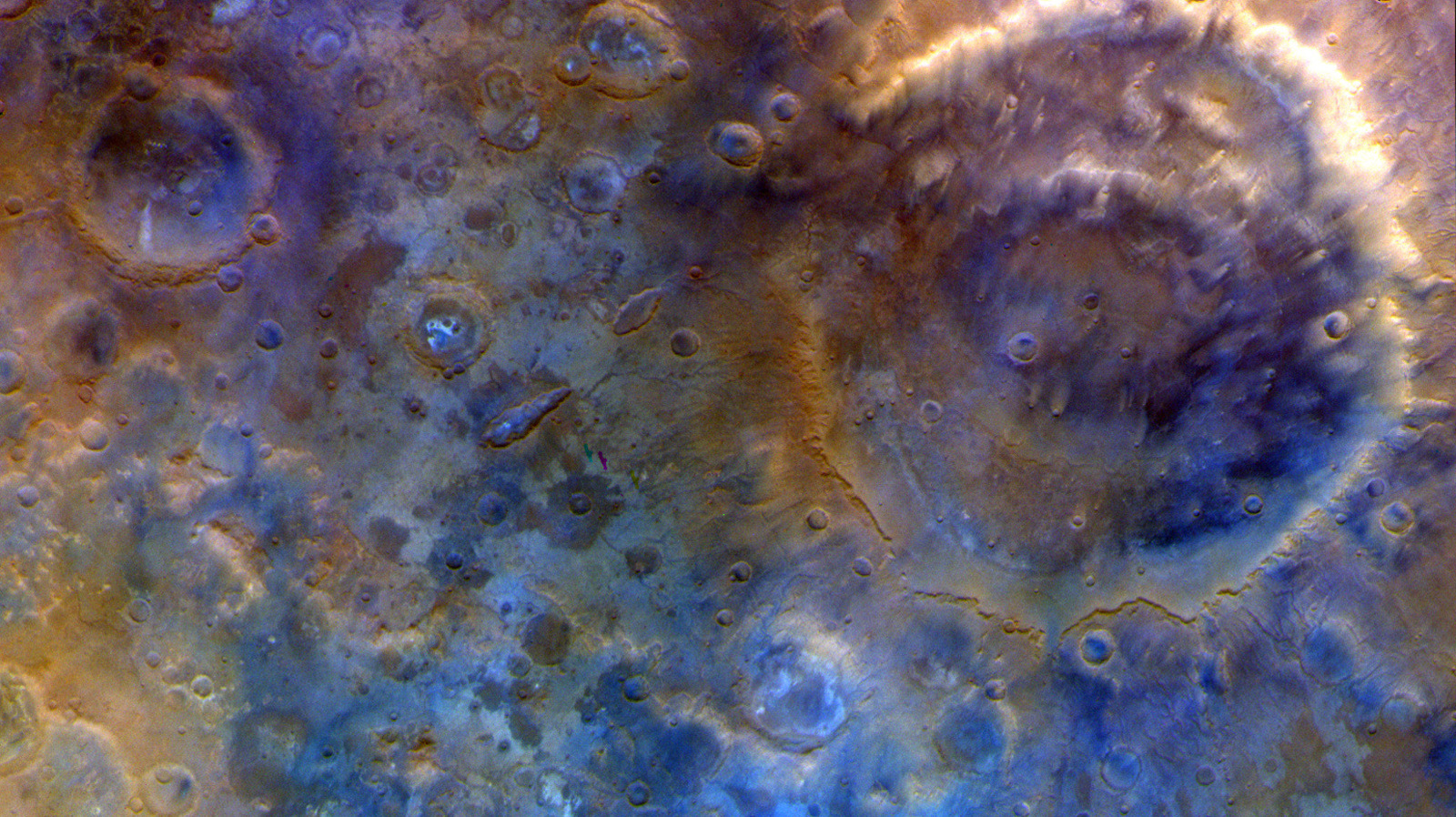
Psyche performed a Mars flyby to gain a gravity assist on its way to the metallic asteroid 16 Psyche. During the closest approach, it imaged the Huygens double-ring crater, about 290 miles across, with colors reflecting differences in dust, sand, and bedrock composition, enhanced to make variations more pronounced. After the closest approach, it captured a high-resolution view of Mars’s southern pole, where water ice remains frozen year-round and appears as a bright region. Earlier, it photographed a crescent Mars as sunlight reflected from the surface and extended farther due to reflection from the dusty atmosphere. After the flyby, Psyche continued using solar-electric propulsion, aiming to reach 16 Psyche in 2029 and orbit it for two years.
"Psyche took an image of the crater, measuring 290 miles in diameter, shortly after its closest approach with the planet. The various colors in the image are a result of the differences in the composition of dust, sand and bedrock, though NASA enhanced the colors to make them more pronounced."
"Psyche was also able to take a high-resolution photo of the southern pole of Mars after its closest approach. The Martian south pole has vast fields of water ice that remain in that state all year round, and they show up as a bright spot in the image."
"Before Psyche took those images, however, the spacecraft took a photo showing a crescent Mars. It was the view the spacecraft saw as it approached Mars from high up, as the planet's surface reflected sunlight. NASA says the crescent appeared brighter and extended farther than the Martian surface because sunlight was also reflected by the planet's dusty atmosphere."
"After getting gravity assist from Mars, Psyche will resume using its solar-electric propulsion system to continue its journey. The spacecraft started its six-year trip to its namesake asteroid back in October 2023. During the flyby, it got closer to Mars than the planet's own moons and passed within 2,800 miles of its surface at its closest approach. The spacecraft is expected to reach its destination in 2029, after which it will spend two years orbiting and observing the asteroid."
#mars-flyby #gravity-assist #spacecraft-imaging #solar-electric-propulsion #metallic-asteroid-16-psyche
Read at Engadget
Unable to calculate read time
Collection
[
|
...
]