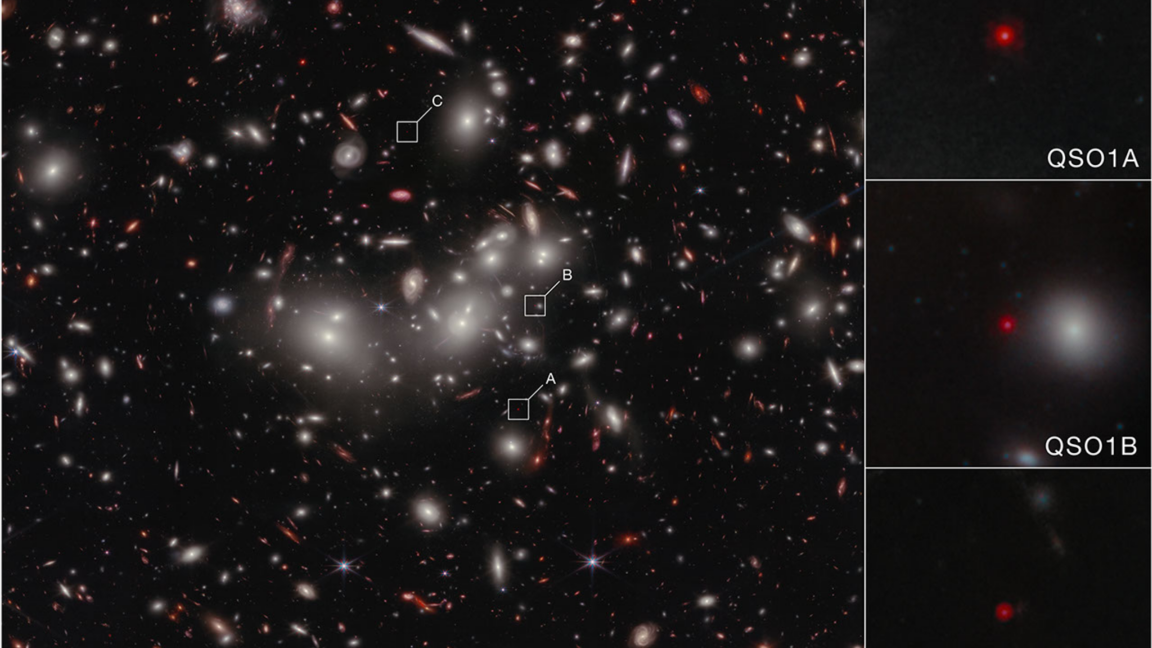
QSO1’s black hole mass is estimated at about 50 million times the Sun’s mass, matching earlier values and indicating consistent luminosity-governing rules over at least 13 billion years. Estimates of stars around the black hole find very few, with the Keplerian rotation curve leaving little room for a stellar component. The total stellar mass in the host “galaxy” has an upper limit of 20 million solar masses, less than half the black hole’s mass. Over two-thirds of QSO1’s mass resides in the black hole, while stars account for less than one-third, motivating the quoted “galaxy.” The scarcity of stars suggests ignoring runaway mergers in dense clusters, leaving primordial black holes or direct collapse as theoretical possibilities, with direct collapse models requiring ultraviolet radiation and more surrounding mass than observed.
"These models placed the black hole's mass at about 50 million times that of the Sun, which is in line with previous estimates. That suggests the rules governing black hole luminosity haven't changed in at least 13 billion years."
"Attempting to estimate the mass of any stars surrounding the black hole suggested there were very few. "The Keplerian rotation curve leaves little room for any stellar component," the researchers conclude. Attempts to estimate the total stellar mass in the "galaxy" that the black hole sits in came up with an upper limit of 20 million solar masses-less than half of the mass of the black hole itself."
"In other words, over two-thirds of the mass of QSO1 resides in the black hole, with the stars accounting for less than one-third. Which explains why the word 'galaxy' is in quotes above. "To our knowledge, this upper limit makes QSO1 the most 'naked' massive BH ever found," the team concludes."
"Here, the researchers argue that having a supermassive black hole with so few stars around suggests we can ignore option three. If there are no dense stellar clusters, you can't form enough black holes to merge. This leaves two mechanisms that are entirely theoretical at this point."
#supermassive-black-holes #qso1 #galaxy-mass-estimates #black-hole-formation-mechanisms #primordial-black-holes
Read at Ars Technica
Unable to calculate read time
Collection
[
|
...
]