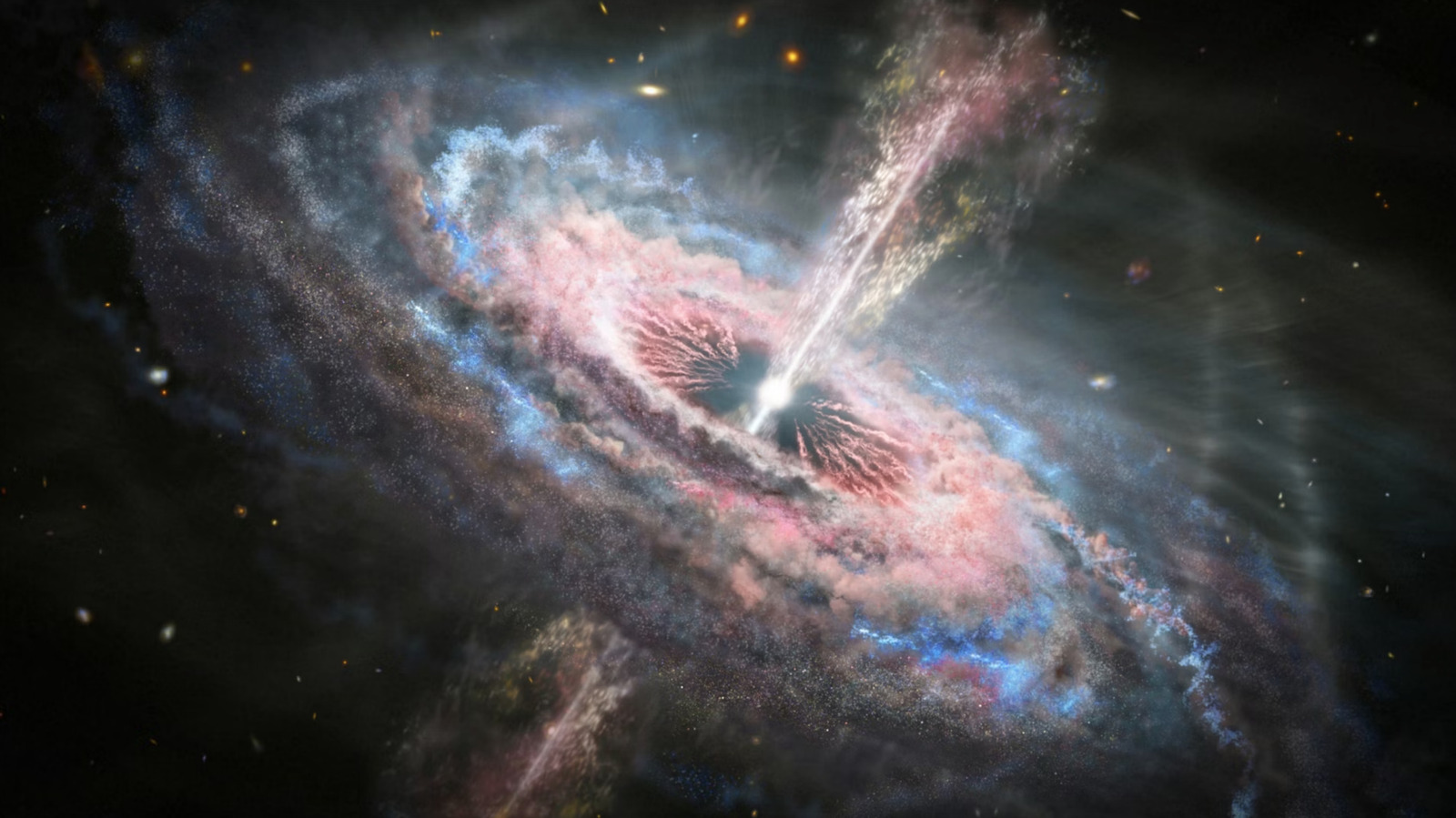
A supermassive black hole was directly measured in the early universe using the James Webb Space Telescope. The object, Abell2744-QSO1 (Little Red Dot QSO1), appears to have existed about 700 million years after the Big Bang, at a distance of 13 billion light-years. Its mass is about 40 million times the Sun’s mass. The black hole likely predates its host galaxy and seems to have formed without a stellar collapse phase. Conventional models often assume large stars collapse within galaxies to create black holes that then grow by feeding on surrounding material. The new evidence indicates rapid early growth and requires revisiting how black holes form and grow.
"The James Webb Space Telescope has observed evidence of a supermassive black hole that was enormous from inception and did not seem to undergo a stellar collapse phase, in which a black hole feeds on a host galaxy to increase its size. Professor Roberto Maiolino from Cambridge's Cavendish Laboratory and Kavli Institute for Cosmology, who co-authored a recent study on the phenomena, calls the findings "a total revisiting of the classical scenarios of how black holes form and grow.""
"Researchers have made the first direct mass measurement of a black hole in the early universe using #NASAWebb. The supermassive black hole in Abell2744-QSO1 seems to predate its galaxy and may have formed within the first second after the big bang: https://t.co/TiRs3ZBBnq pic.twitter.com/8fuiVQYYEV"
"Most of these little red dots are thought to be supermassive black holes surrounded by thick gas from the early universe. This particular little red dot likely existed just 700 million years after the Big Bang. It has long been thought that it took at least a billion years for a supermassive black hole to form. The astronomical body is 40 million times the size of our sun, and is located 13 billion light-years away."
#james-webb-space-telescope #supermassive-black-holes #early-universe #galaxy-formation #astronomy-observations
Read at Engadget
Unable to calculate read time
Collection
[
|
...
]