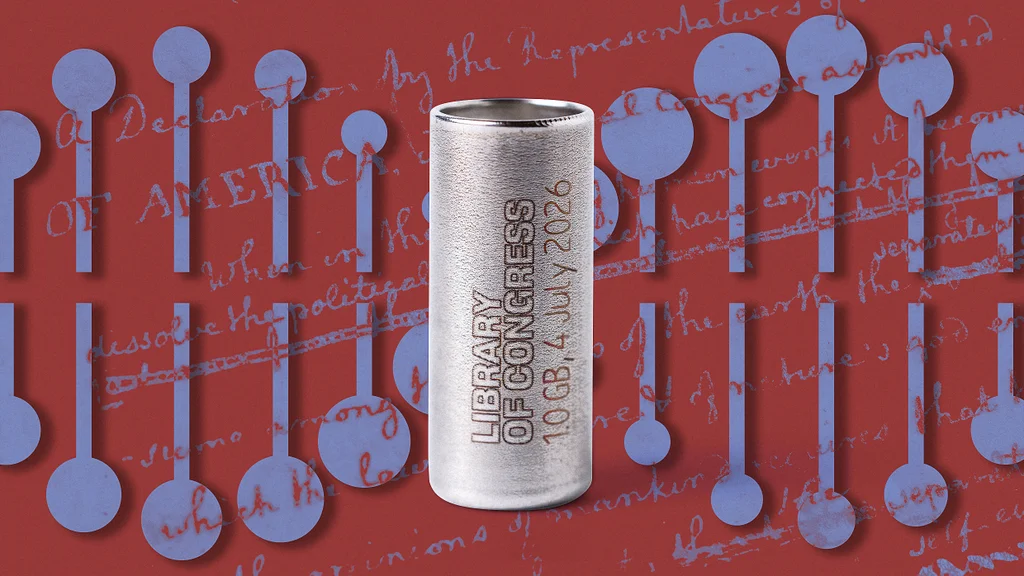
A time capsule marking 250 years since the founding will store U.S. historical documents and media in a vial using synthetic DNA. Data is converted from 0s and 1s into DNA bases—adenine, cytosine, guanine, and thymine—so information can be packed far more densely than paper or other storage methods. The approach is not biological, but it uses DNA structure to improve storage density and longevity. The vial will hold about 1 gigabyte of data, including digital copies of Thomas Jefferson’s rough Declaration draft, Francis Scott Key’s lyrics to “The Star-Spangled Banner,” and the Annals of Congress from 1789 to 1824. It will also include audio, 3D renderings, maps, and rare manuscripts chosen by a cross-library group.
"The storage technique uses artificial DNA molecules like a hard drive by converting data sequenced in 0s and 1s, the binary language of computers, into As (adenine), Cs (cytosine), Gs (guanine), and Ts (thymine), the bases that make up a DNA molecule."
"It's not biological in any way, but it does use DNA structure to pack data more densely than other storage methods, and it lasts far longer than paper would. For a time capsule that's not supposed to be open until 2276, it's a smart way to preserve history for the long run."
"The vial from the Library of Congress includes digital copies of documents like Thomas Jefferson's rough draft of the Declaration of Independence and Francis Scott Key's hand-written lyrics of "The Star-Spangled Banner," as well as the entire Annals of the Congress of the United States from 1789 to 1824, which detail congressional proceedings."
"All told, it's 1 gigabyte of data, or several social studies lessons' worth of history, all shrunken down so it can fit into a container no taller than a quarter. The items were chosen by a a cross-library group."
Read at Fast Company
Unable to calculate read time
Collection
[
|
...
]