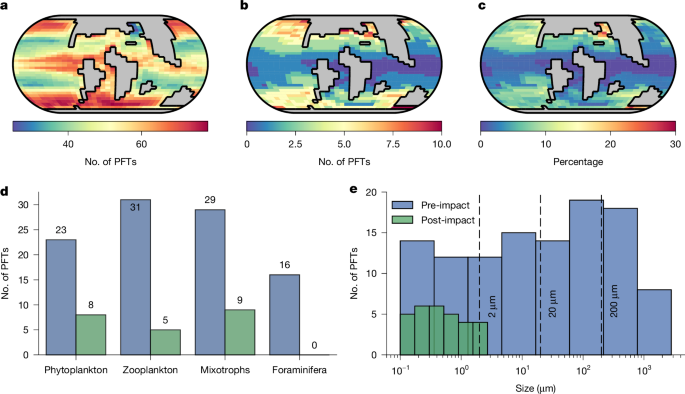
The K-Pg boundary at 66 Ma marks a mass extinction that reshaped marine and terrestrial life. The Chicxulub asteroid impact and associated wildfires are supported as the main trigger of marine extinction through abrupt environmental change. Silicate dust, soot, and sulfur aerosols blocked solar radiation, reduced light, and produced global cooling. Wildfires and vaporization of carbonate-rich target rock increased atmospheric CO2 by about 700 ppm. Extinction patterns were selective: nearly all nannoplankton, planktic foraminifera, rudist bivalves, and ammonoid cephalopods disappeared, while dinoflagellates, diatoms, radiolarians, and benthic foraminifera were less affected. High-latitude nannoplankton in the Southern Ocean show lower extinction rates than low-latitude forms, and surviving plankton were small and opportunistic.
"The bolide impact and associated wildfires released silicate dust, soot and sulfur aerosols into the atmosphere9, blocking solar radiation and causing the reduction of light and global cooling11. Simultaneously, global wildfires and the vaporization of carbonate-rich target rock increased CO2 concentrations by approximately 700 ppm across K-Pg12."
"In the ocean, nearly all nannoplankton, planktic foraminifera, all rudist bivalve and ammonoid cephalopod molluscs went extinct. By contrast, dinoflagellates, diatoms, radiolarians and benthic foraminifera were less affected17,18. Notably, high-latitude nannoplankton7, particularly in the Southern Ocean, have exhibited lower extinction rates than their low-latitude counterparts, and a similar pattern might exist for planktic foraminifera19."
"However, Northern Hemisphere high-latitude data remain limited7 and such a latitude-dependent extinction was not found in molluscs20. Furthermore, surviving nannoplankton and foraminifera were small and opportunistic4,21, with similar size reductions found in other marine organisms22."
"Despite advances in reconstructing the sequence of events across the K-Pg boundary, it is still unclear how environmental changes caused observed extinction patterns13. Several hypotheses have been proposed to explain these ecological and geographical selective extinction patterns across the K-Pg boundary."
Read at Nature
Unable to calculate read time
Collection
[
|
...
]