Water molecules enable life by acting as a solvent that preserves biomolecule structure and function in cells. Cellular water exists as interfacial water bound to macromolecules in a hydration layer and free water that diffuses in the bulk. Water potential reflects the availability of free water and controls water uptake from soil and transport in plants. Cellular water potential shifts with environmental conditions, especially drought, high salinity, and temperature stress. Reduced cellular water potential lowers biomolecule hydration, weakening membrane integrity, disrupting protein three-dimensional structures, and impairing enzymatic activity. Biomolecular condensation is proposed as a sensing mechanism because water influences hydrophobic, electrostatic, and cation–π interactions that drive condensation.
"Water molecules are central to life, providing a solvent that maintains the functional structures and activities of biomolecules within cells. Cellular water molecules are bound by macromolecules, forming the hydration layer or freely diffuse in the bulk. These two portions of water are referred to as interfacial water and free water, respectively1. Water potential, which can be understood as the availability of free water, governs water uptake from the soil and transport within the plant3,4. The cellular water potential is sensitive to environmental fluctuations, particularly drought, high salinity and temperature stress1,2,5."
"Cellular water-potential reduction decreases hydration of biomolecules, compromising membrane integrity, disrupting the three-dimensional structures of proteins, impairing enzymatic activities, and so on7. Therefore, cellular water-potential sensing and response are crucial for plant development and adaptation to various environmental stresses, but the mechanisms underlying them remain unknown."
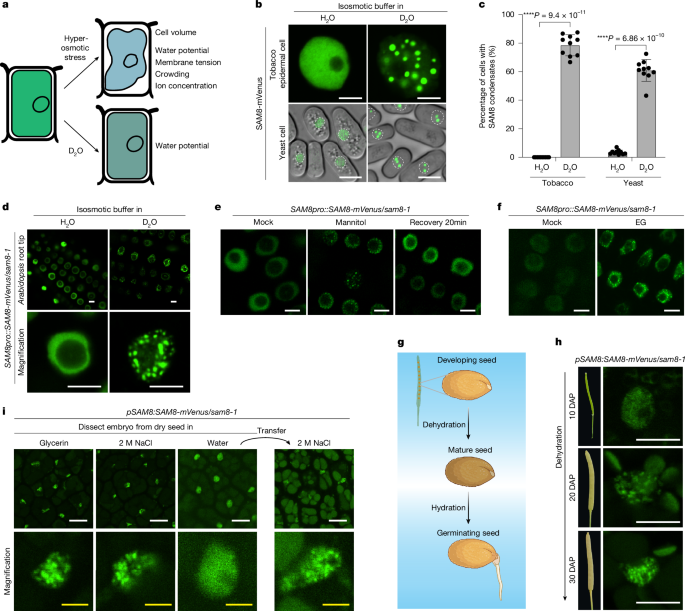
"Biomolecular condensation is emerging as a key mechanism for sensing and responding to environmental stress8,9. Hyperosmotic stress often induces cell volume shrinkage, resulting in membrane tension changes, water-potential reduction and subsequent dehydration of biomolecules, increased molecular crowding and ion concentration10 (Fig. 1a and Extended Data Fig. 1a). Both nuclear and cytoplasmic proteins were reported to sense hyperosmotic stress by molecular crowding-dependent condensation in plants11,12."
"We reasoned that biomolecular condensation can be a way of sensing cellular water-potential changes because water tunes the strength of hydrophobic interactions, electrostatic interactions or the cation-π interactions, all of which are the driving force for condensation. Deuterium oxide (D 2O) forms stronger"
#plant-stress-response #water-potential #biomolecular-condensation #protein-hydration #osmotic-stress
Read at Nature
Unable to calculate read time
Collection
[
|
...
]