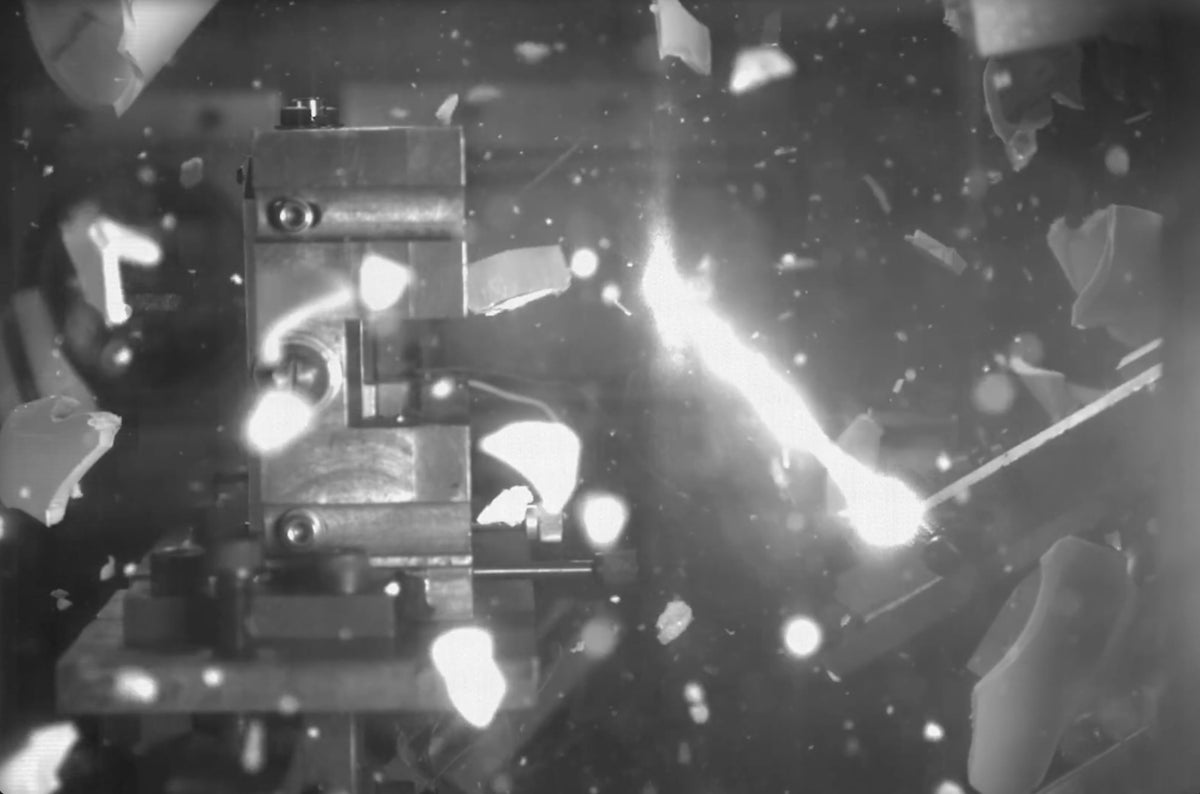
"D. radiodurans is the closest thing we can get to what we think a Martian life-form might look like without having an alien in our lab, says Lily Zhao, a doctoral student at Johns Hopkins University, who led the experiment. And we tried to kill it, but we couldn't."
"The bacteria could withstand split-second exposures to extreme pressures of up to three gigapascals (GPa). That's 30 times greater than pressures at the deepest point in Earth's oceans—and similar to the crushing blow of an asteroid cratering into Mars and blasting fragments into space."
"Our expectation was that most of them would die, he says, because other types of microbes in previous high-pressure studies had survival rates of only about 1 percent or less. Instead nearly all the D. radiodurans microbes survived initial 1-G"
Deinococcus radiodurans, known as one of Earth's toughest organisms, demonstrates remarkable resilience to extreme conditions including cold, radiation, chemicals, and dehydration. Researchers at Johns Hopkins University conducted experiments exposing this bacterium to pressures simulating asteroid impacts on Mars by firing high-speed projectiles at bacterial colonies sandwiched between steel plates. The microbes withstood pressures up to three gigapascals, equivalent to 30 times the pressure at Earth's ocean depths and comparable to asteroid cratering forces. Nearly all bacteria survived initial exposure, far exceeding survival rates of other microbes in similar studies. These findings suggest D. radiodurans could potentially survive the mechanical stresses of interplanetary transfer, supporting theories about microbial panspermia and the possibility of life dispersal across the solar system.
Read at www.scientificamerican.com
Unable to calculate read time
Collection
[
|
...
]