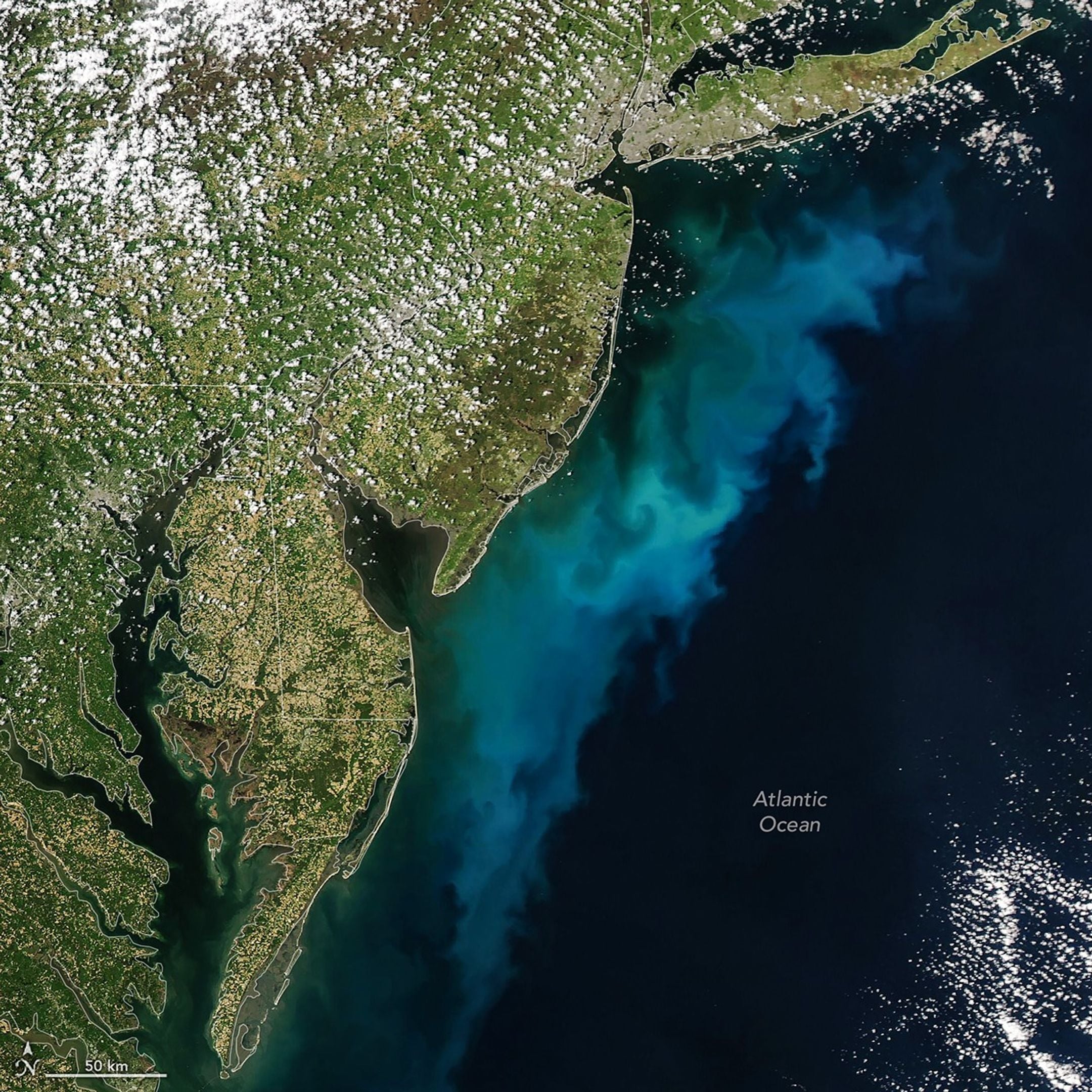
Bright blue and blue-green water has appeared along the Atlantic coast from New York to Maryland, spreading from the Mid-Atlantic Bight. The vivid colors began in early April and persist in patches near shallow coastal zones off New Jersey, Delaware, Maryland, and Virginia. Scientists link the color shift to massive spring phytoplankton blooms developing offshore, influenced by microscopic marine organisms, river runoff, suspended sediment, and nutrient-rich ocean conditions. The Mid-Atlantic Bight is difficult to analyze from space because coastal waters contain rapidly changing mixtures of sediment, dissolved organic material, seagrass, algae, and phytoplankton. Newer NASA satellite technology, including PACE, detects these blooms with greater detail by measuring more wavelengths of light.
"Satellite images captured by NASA are showing an unusual stretch of bright blue and blue-green water spreading along the Atlantic coast from New York to Maryland, with scientists linking the dramatic color shift to massive spring phytoplankton blooms developing offshore."
"The vivid waters began appearing in early April near the Mid-Atlantic Bight, a heavily studied coastal zone where the Atlantic Ocean mixes with outflows from Raritan Bay, Delaware Bay, and Chesapeake Bay. Researchers say the striking colors likely stem from a combination of microscopic marine organisms, river runoff, suspended sediment, and nutrient-rich ocean conditions triggered by seasonal changes."
"Researchers say the Mid-Atlantic Bight has historically been difficult to analyze from space because coastal waters contain a constantly changing mix of sediment, dissolved organic material, seagrass, algae, and phytoplankton. "That optical complexity has made it harder for scientists to distinguish and categorize phytoplankton blooms in shallow coastal zones," NASA explained."
"The recently launched PACE mission - short for Plankton, Aerosol, Cloud, Ocean Ecosystem - is changing that. The satellite, launched in 2024, measures more wavelengths of light than previous ocean-monitoring missions, giving researchers a sharper view of biological activi"
#nasa-satellites #phytoplankton-blooms #ocean-color-remote-sensing #mid-atlantic-bight #atlantic-coast
Read at Shore News Network
Unable to calculate read time
Collection
[
|
...
]