"Like physics, math has its own set of fundamental particles—the prime numbers, which can't be broken down into smaller natural numbers. They can only be divided by themselves and 1. And in a new development, it turns out these mathematical particles are offering new ways to tackle some of physics' deepest mysteries."
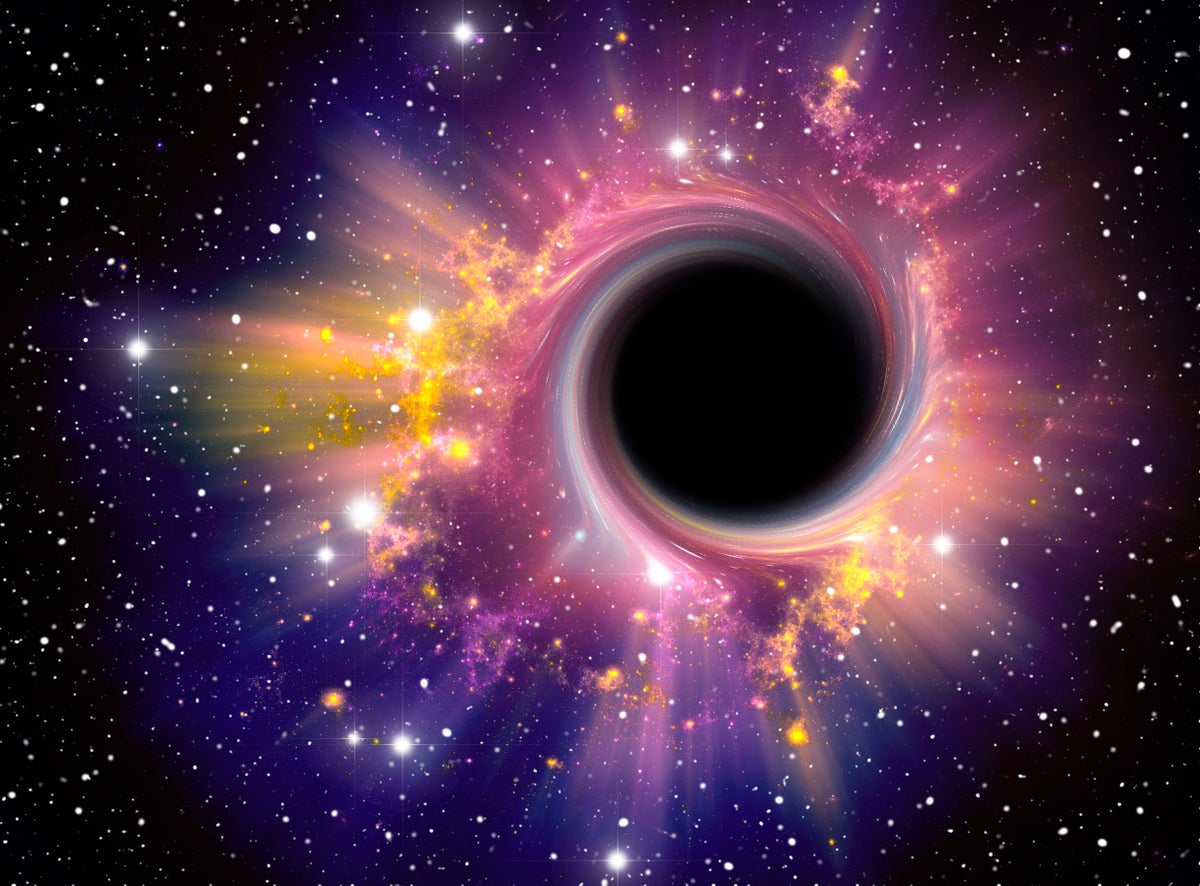
"Black holes are the sites of the universe's most crushing gravitational force. At their centers lie single points called singularities, where classical physics predicts that gravity must be infinite, causing our understanding of space and time to break down. But in the 1960s, physicists found that, immediately surrounding the singularity, a type of chaos emerges—and it looks remarkably similar to a kind of chaos recently found in the primes."
"Number theorists have spent hundreds of years deriving theorems and conjectures based on the primes. These new connections suggest that the mathematical truths that govern prime numbers may also govern some fundamental laws of the universe."
Prime numbers, indivisible by any natural number except themselves and 1, serve as mathematics' fundamental building blocks. Recent research demonstrates that formulas based on primes can describe black hole properties. The chaos observed near black hole singularities mirrors chaos patterns discovered in prime number distributions. These connections suggest that mathematical principles governing primes may also underlie fundamental physical laws. The Riemann hypothesis, a foundational conjecture about prime distribution from 1859, provides mathematical frameworks that physicists are beginning to apply to understanding black holes and other cosmic phenomena. This emerging interdisciplinary field bridges number theory and high-energy physics.
Read at www.scientificamerican.com
Unable to calculate read time
Collection
[
|
...
]