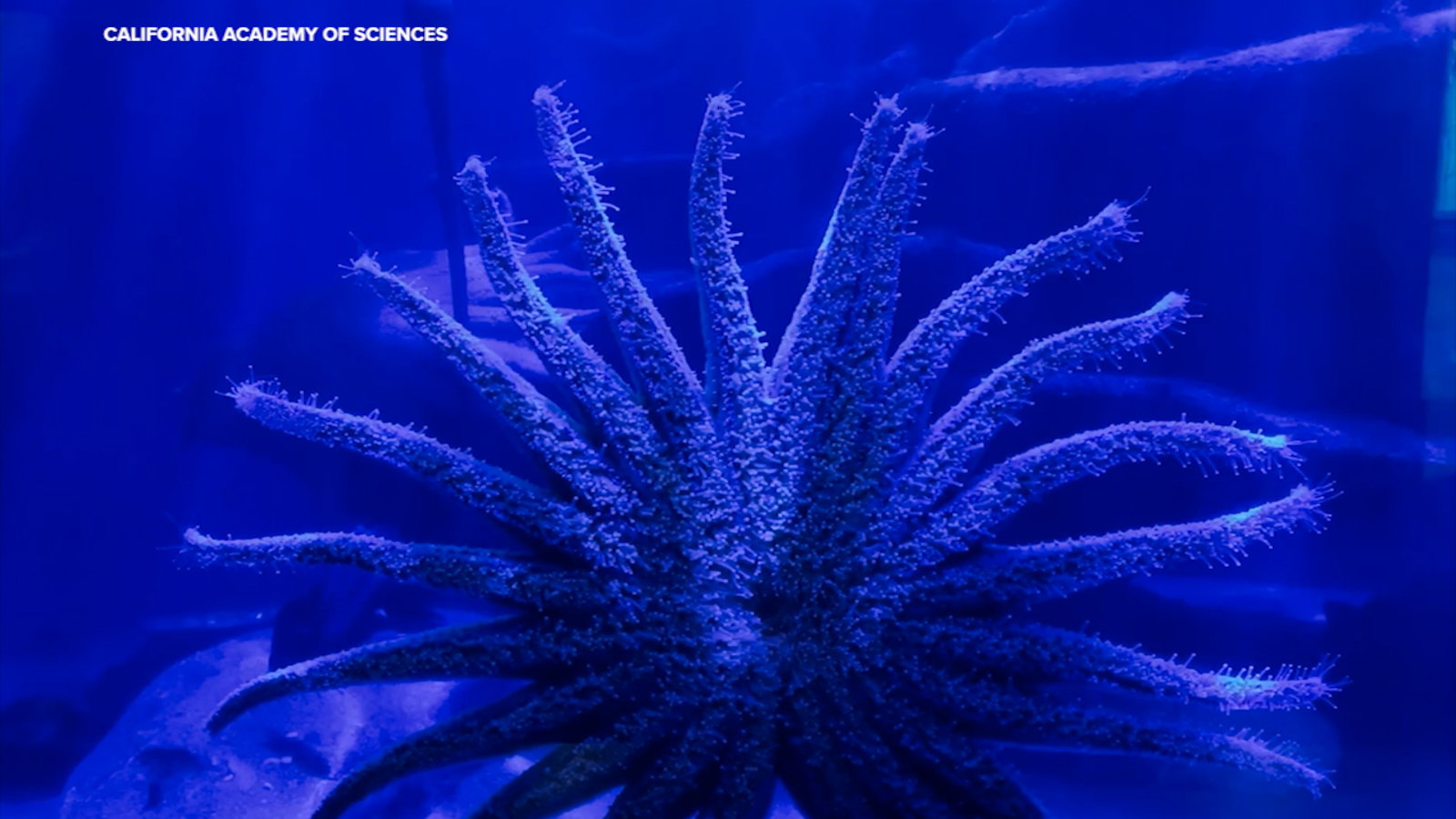
"“So, these are all animals raised in captivity,” said Marine Researcher Riah Evin, who added that a number of them recently took a leap into the real world. In a unique experiment, beginning several months ago, the lab-grown stars were placed in cages in Monterey Bay for a full-on soak test, to see if they could survive in the open ocean before being retrieved."
"“So it was a test to see animals that had never touched the ocean before, how they would do and release them. And everybody got through it fine,” she said. PREVIOUS STORY: New California Academy of Sciences research could help sea star recovery along Bay Area coastline And that success is especially critical now, because the species has nearly disappeared from their normal coastal environment, victims of a sea star wasting disease."
"“So now that our colleagues have identified this bacterium that is causing sea star wasting disease, it really opens up this huge new set of research questions that we can start to address,” said Evolutionary Biologist Elora Lopez-Nadam, Ph.D. Ultimately, could scientists identify and raise healthy stars and reintroduce them into the ocean? Lopez-Nandam says a new project now und"
Sunflower sea stars are being raised in captivity as gametes in nurturing tanks at the California Academy of Sciences. Newly raised animals were placed in cages in Monterey Bay for an open-ocean soak test to evaluate survival after never touching the ocean before. The animals were retrieved after the test, and all passed. Sea star wasting disease has nearly eliminated the species from normal coastal environments. The loss of sea stars triggered a chain reaction in which sea urchins increased and began consuming kelp forests. Scientists identified the bacterium that causes the disease, enabling new research questions. A new project aims to identify and raise healthy sea stars for reintroduction into the ocean.
Read at ABC7 San Francisco
Unable to calculate read time
Collection
[
|
...
]